blog

All articles

77 articles

37–48 of 77 articles · Page 4 of 7

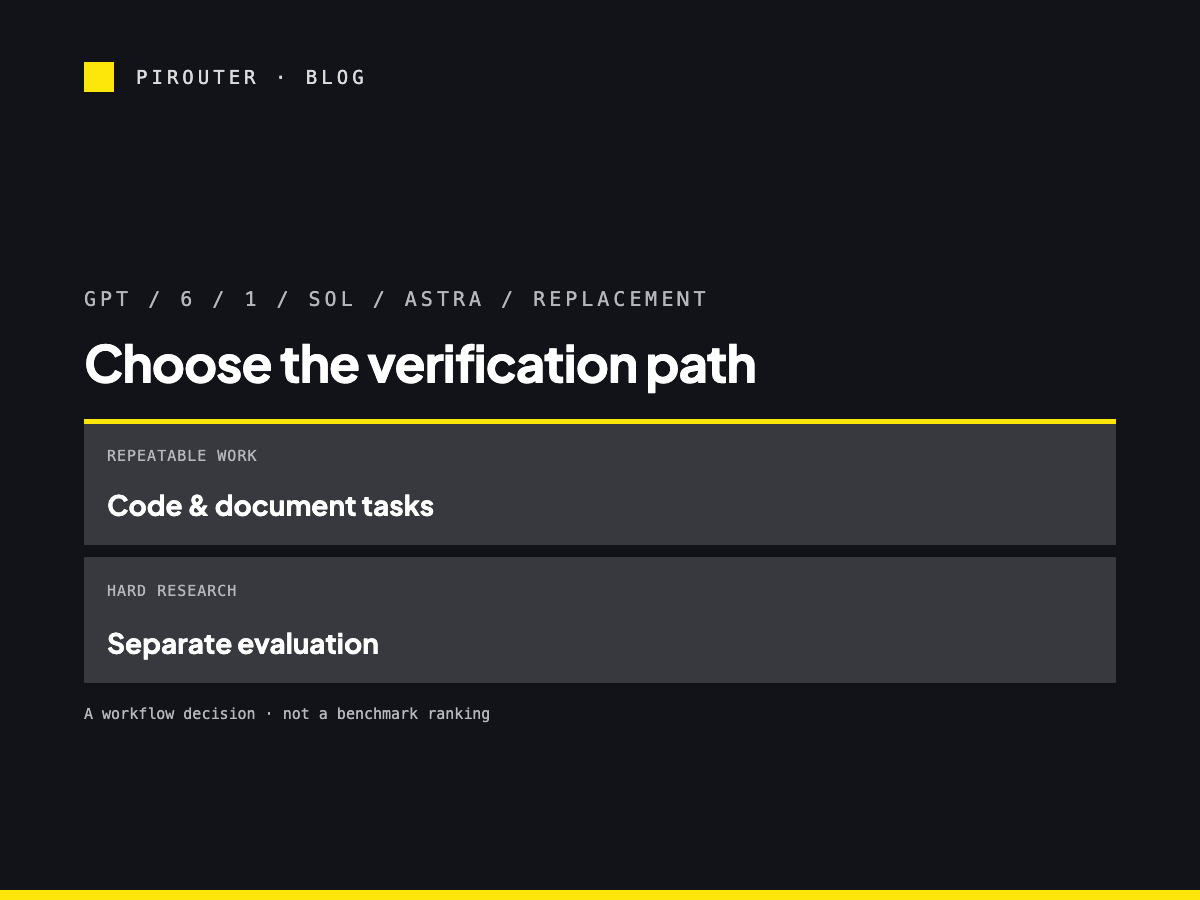
  1. Two labeled panels separate repeatable coding and document work from difficult research tasks that need a separate evaluation; this is not a benchmark chart.

    GPT-6.1 Sol vs Astra: move the testable work, keep the hard calls

    Linden Kern
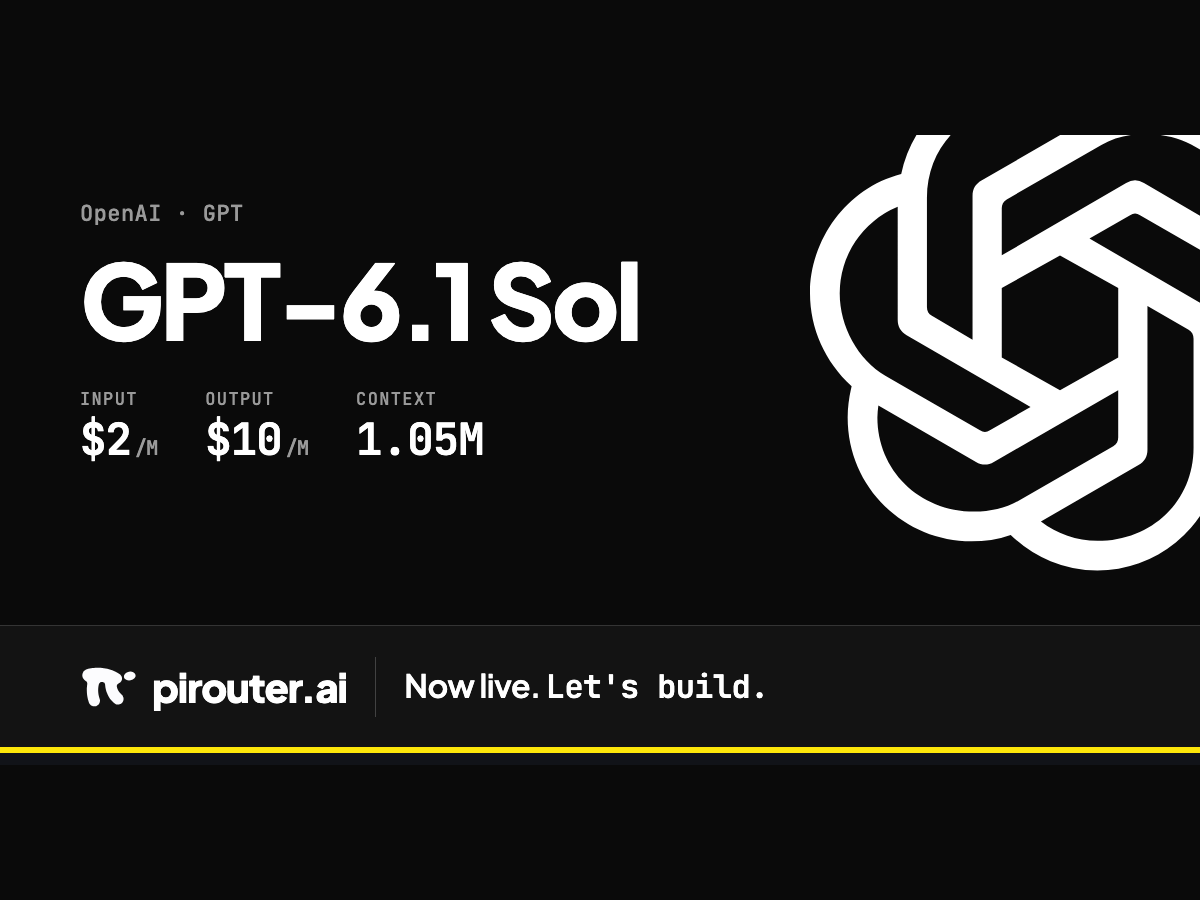
  2. Unmodified GPT-6.1 Sol pirouter model card centered on a black background, showing standard input and output rates, 1.05M context, and the complete footer.

    GPT-6.1 Sol on pirouter: $2/M input and a listed long-context tier

    PiRouter Team
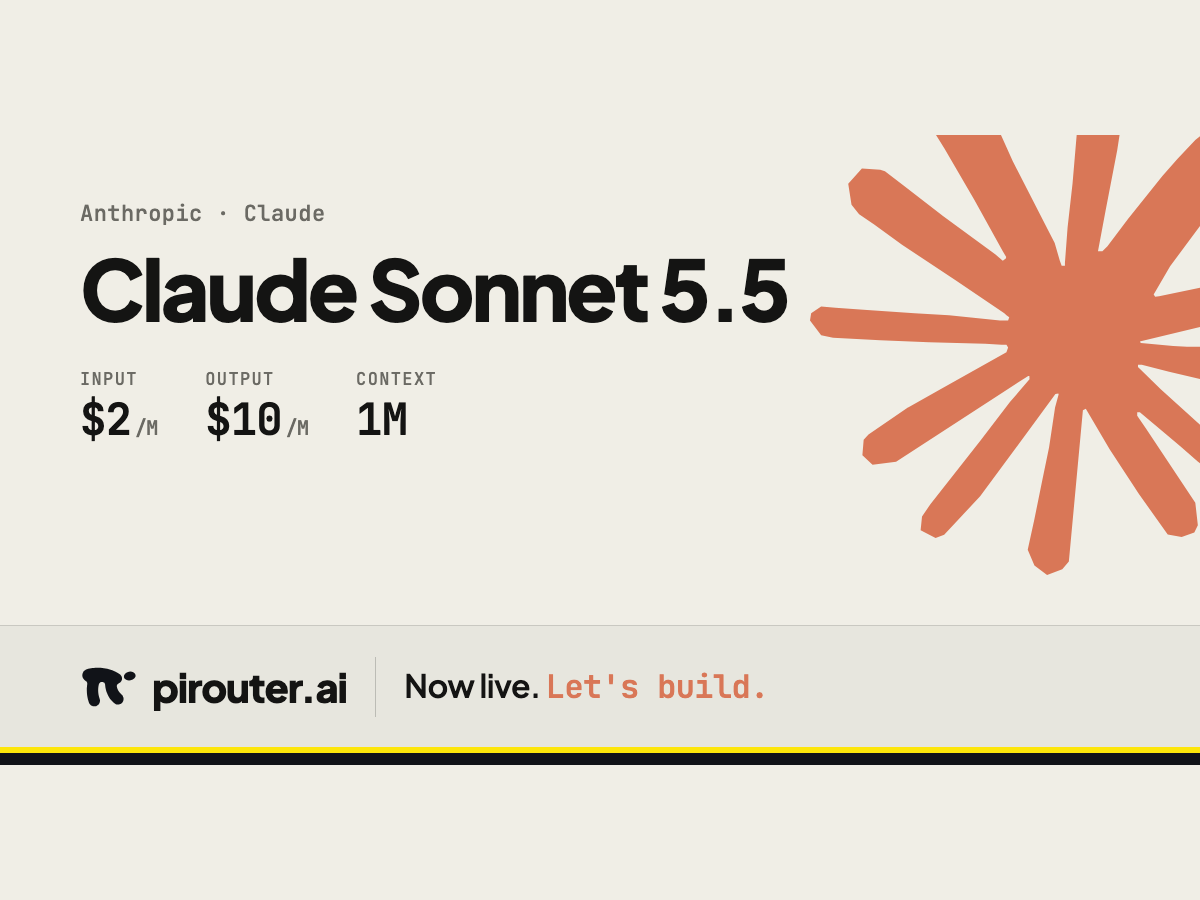
  3. Unmodified Claude Sonnet 5.5 pirouter model card centered on a warm cream background, showing standard input and output rates, 1M context, and the complete footer.

    Claude Sonnet 5.5 on pirouter: exact model ID and $2/M standard input

    PiRouter Team
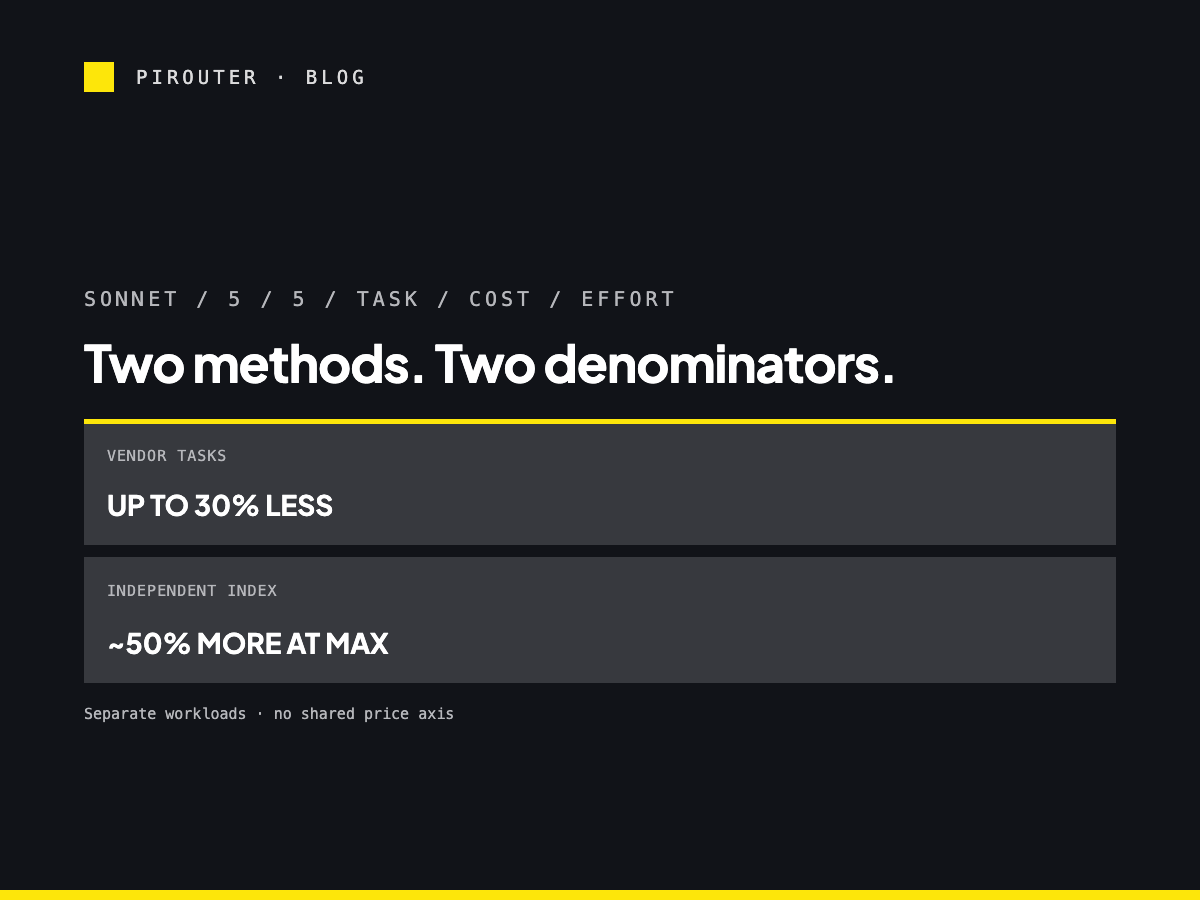
  4. Separate vendor task savings and independent max-effort Index cost measurements appear in two independent panels, not on one axis.

    Claude Sonnet 5.5 task cost: why 30% less and 50% more describe different tests

    Linden Kern
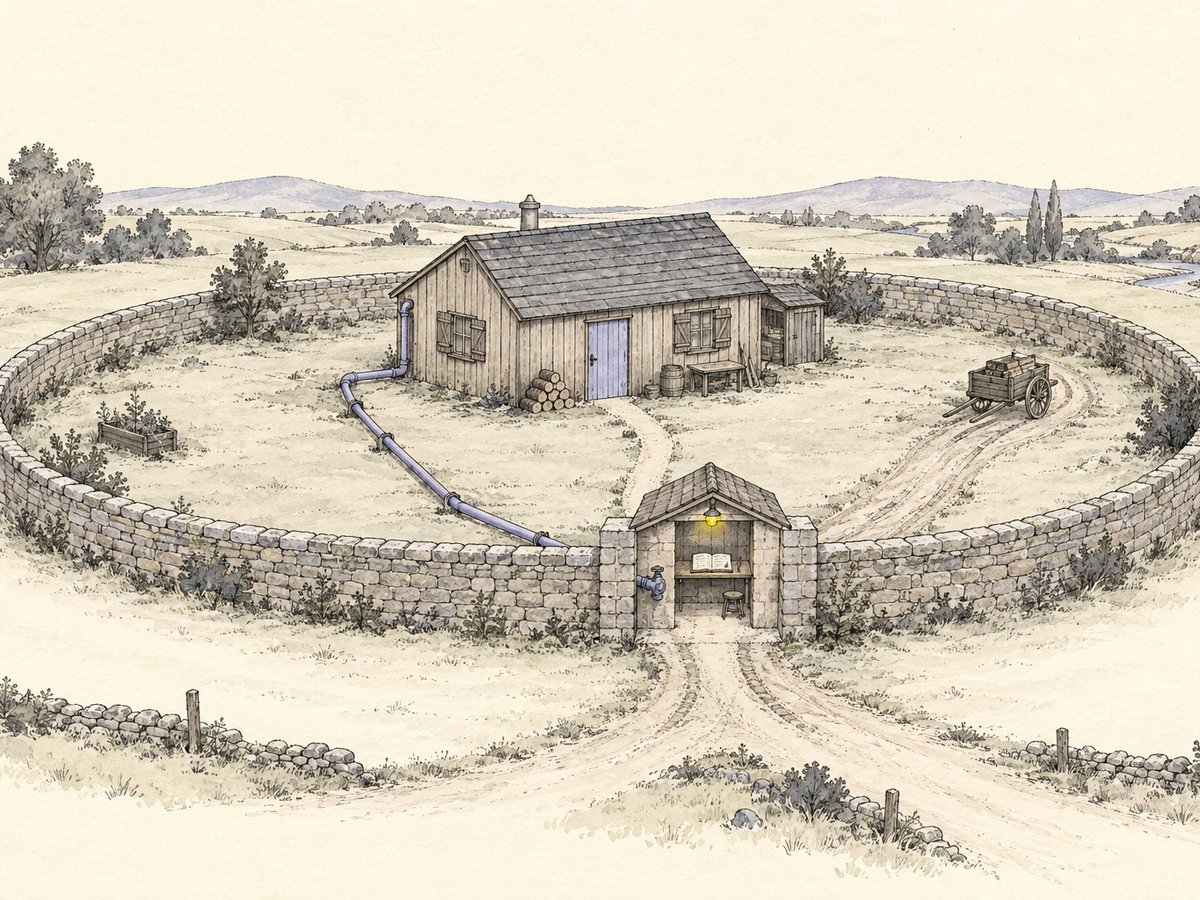
  5. Hand-drawn illustration: a small wooden workshop inside a round stone-walled yard. Every way out, the footpath from its door, a cart track and a thin pipe running along the ground, converges on one small gatehouse in the wall, where an open ledger lies on the counter under a single yellow lamp.

    ZCode packed git history for upload, an OpenAI agent got out via DNS: 4 egress checks you can run

    Leo Kaka
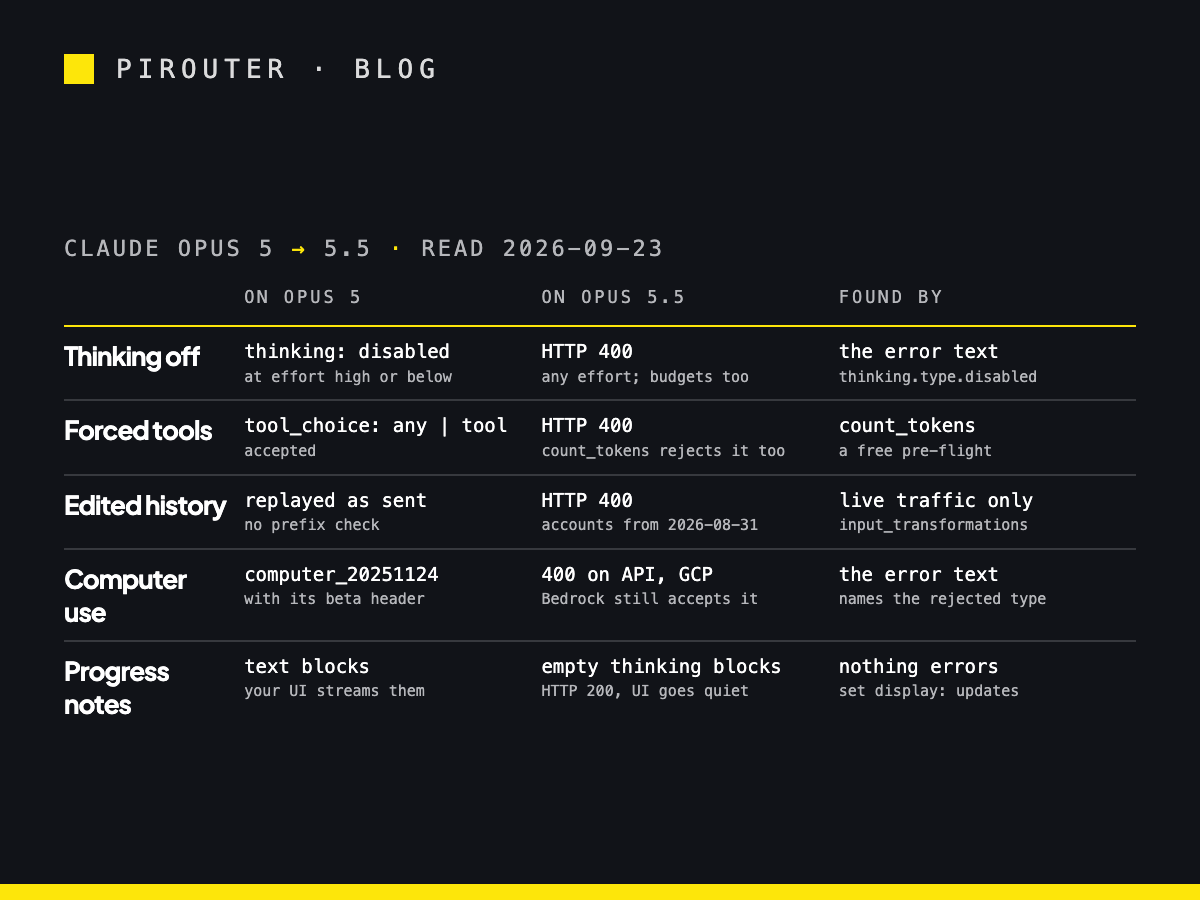
  6. Table of five changes from Claude Opus 5 to Claude Opus 5.5: thinking off, forced tools, edited history, computer use and progress notes, with what Opus 5 accepted, what Opus 5.5 returns (four HTTP 400s and one HTTP 200 with a quiet UI), and how you find out for each

    What breaks when you switch to Claude Opus 5.5: four 400s, three silent changes, and what your fallback loses

    Leo Kaka
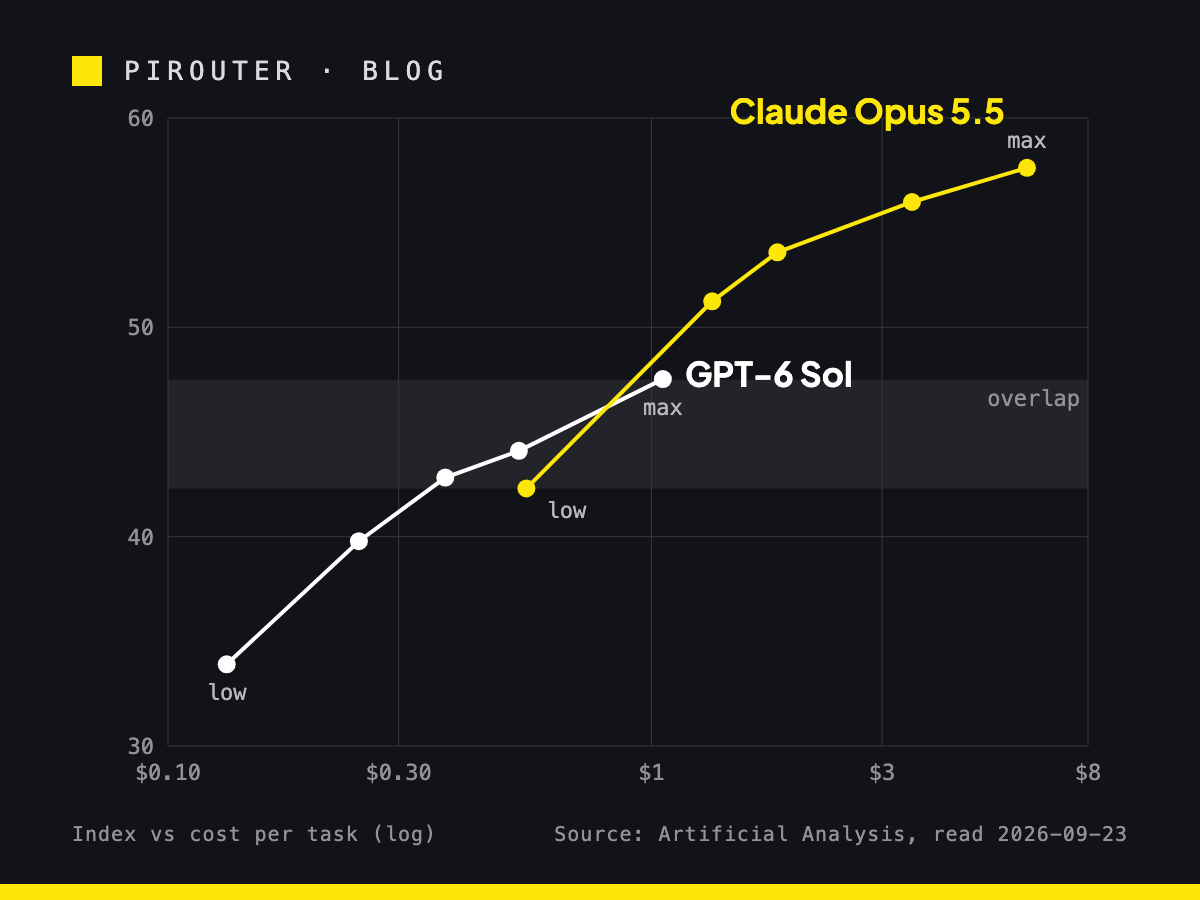
  7. Scatter chart on a dark background: two lines of five points each, one for GPT-6 Sol and one for Claude Opus 5.5, plotting Artificial Analysis Intelligence Index score against cost per task on a log scale from low to max effort. Sol runs from 34 points at $0.13 to 47.5 at $1.06; Opus 5.5 runs from 42 points at $0.55 to 57.6 at $5.98. The two lines overlap only between about 42 and 47.5 points.

    GPT-6 Sol vs Claude Opus 5.5 cost per task: Sol costs 28% to 79% as much for the same target score

    Leo Kaka
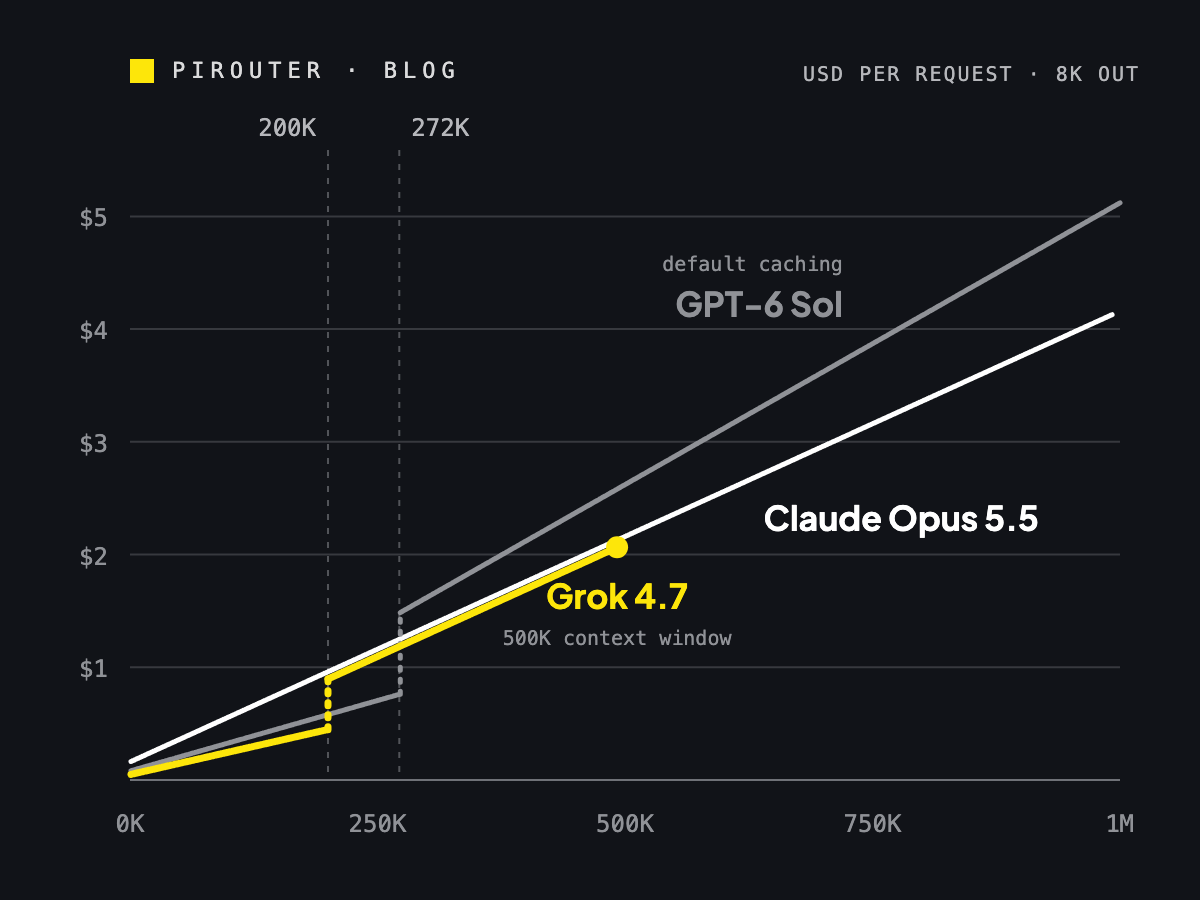
  8. Line chart of the cost of one request against prompt size from 0 to 1M tokens, 8K output, with GPT-6 Sol at its default caching setting. Grok 4.7 (yellow) jumps at 200K and ends at its 500K context window; GPT-6 Sol (grey) jumps at 272K and runs above the others from there; Claude Opus 5.5 (white) rises in a straight line with no step.

    What a 250K prompt costs on Grok 4.7, GPT-6 Sol and Opus 5.5: the 200K and 272K price cliffs

    Leo Kaka
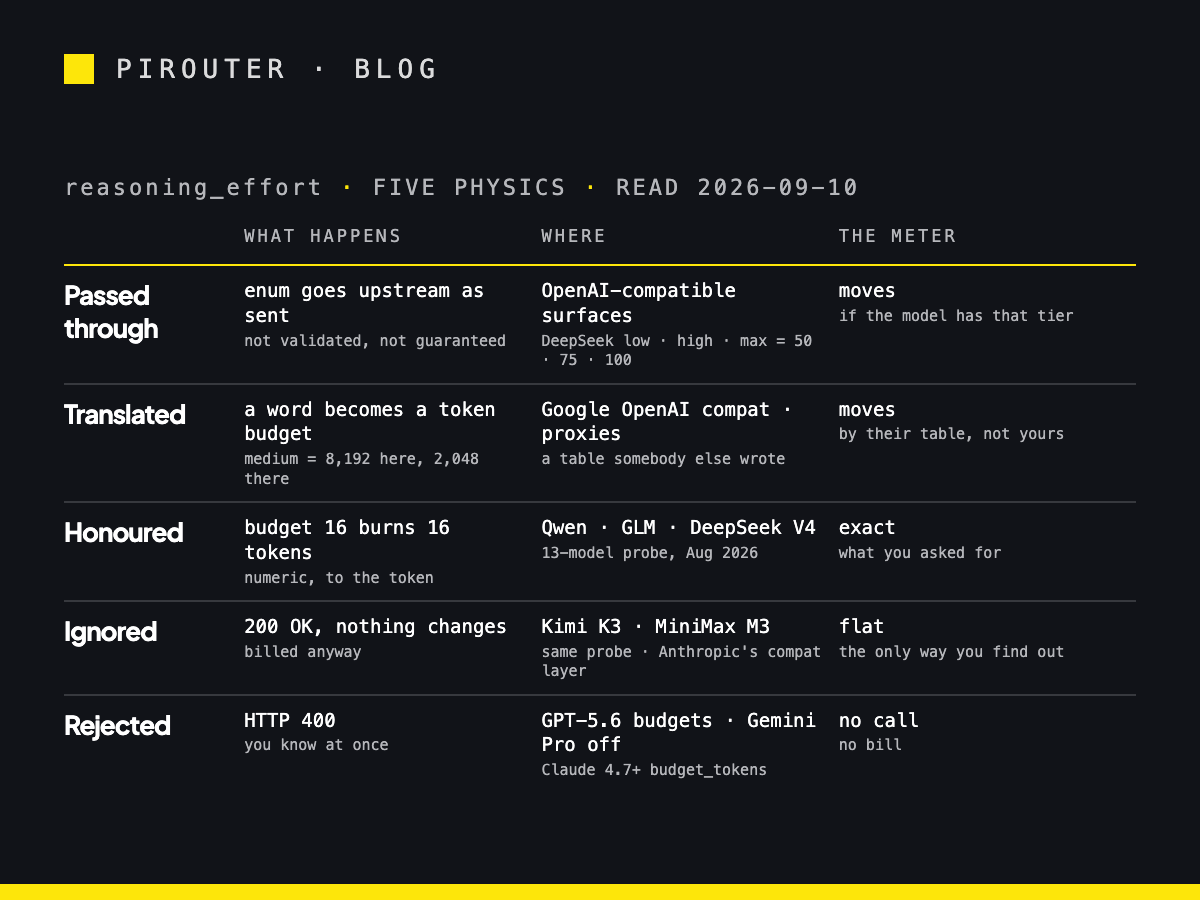
  9. Matrix of the five things that can happen to a reasoning_effort value after a 200 response: passed through, translated into a token budget, honoured to the token, accepted and ignored, rejected with 400, with where each is documented and what the reasoning-token meter does

    What reasoning_effort actually does on DeepSeek, OpenAI, Anthropic and Gemini: one name, five physics, and a five-line test

    Leo Kaka
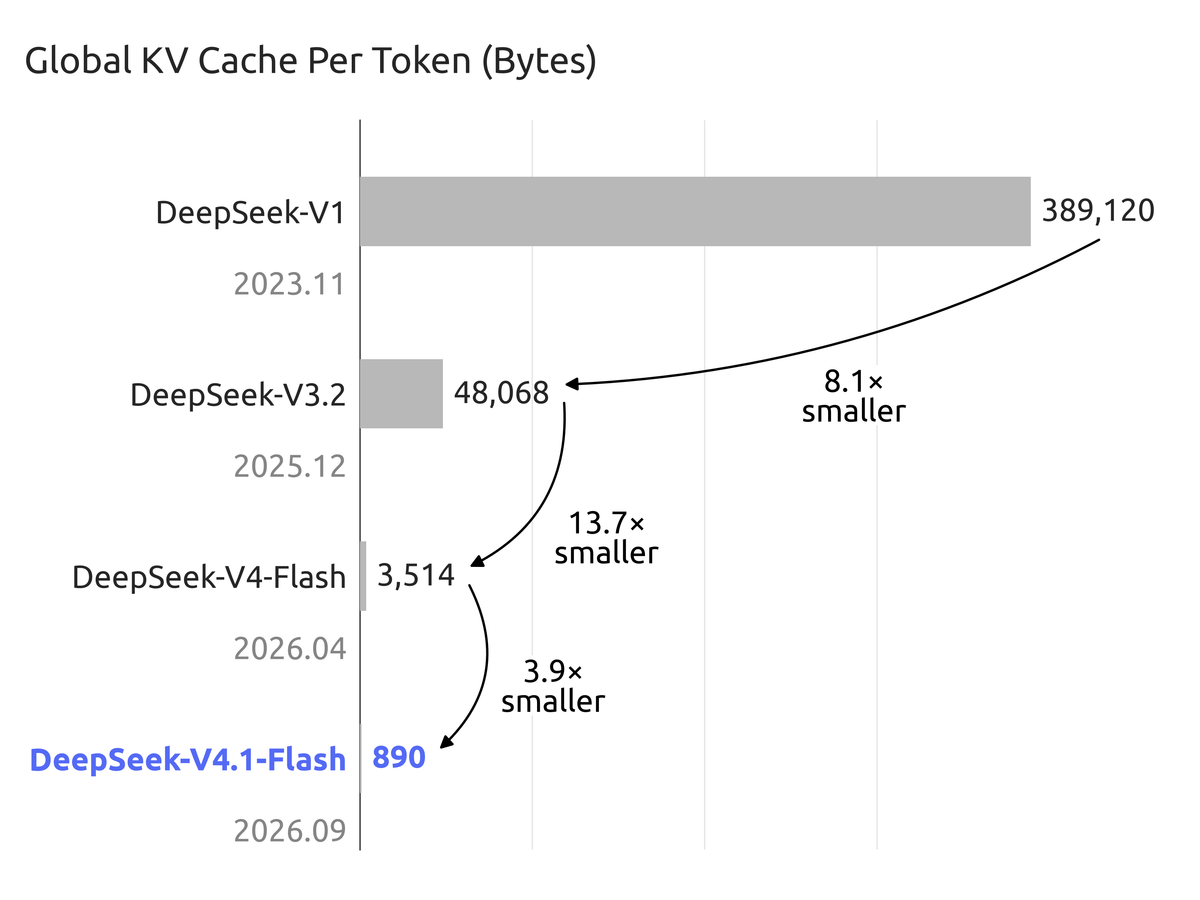
  10. DeepSeek's official chart of global KV cache bytes per token across generations: V1 389,120, V3.2 48,068, V4-Flash 3,514, V4.1-Flash 890, the reason the vendor gives for the Flash price coming down

    DeepSeek V4.1 Flash price cut: 9% to 57% depending on your token mix, and the deepseek-v4-pro switch DeepSeek later reversed

    Leo Kaka
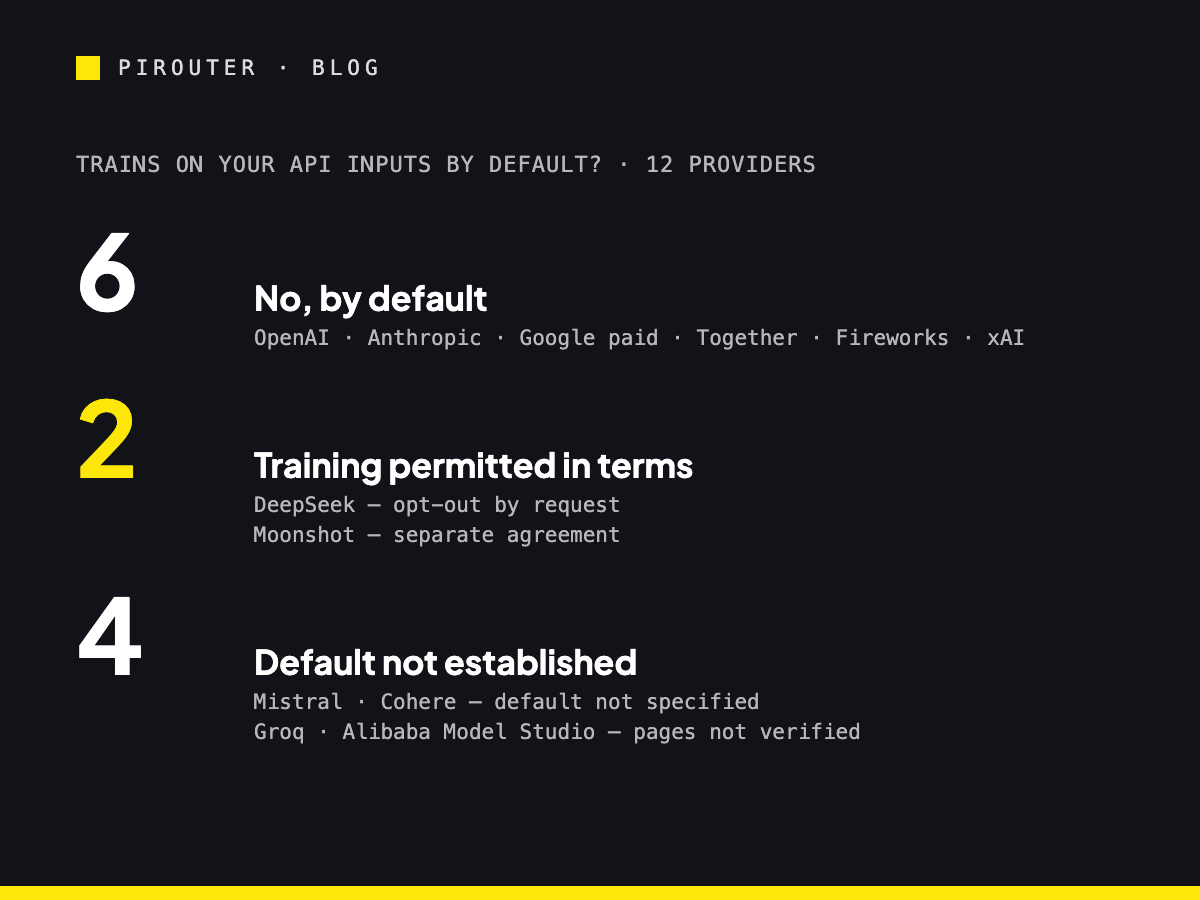
  11. Dark data card comparing twelve LLM providers' API-data training terms: six state no training by default (OpenAI, Anthropic, Google paid tier, Together, Fireworks, xAI); DeepSeek and Moonshot permit training under their published terms; Mistral and Cohere describe opt-out controls without establishing every API product's default; Groq and Alibaba Model Studio could not be verified from the pages read. The three groups total 6, 2 and 4; the footer distinguishes permission to train from proof of actual training.

    Does OpenAI train on your API data? 12 providers, 3 answers, one 30-day default

    PiRouter Team
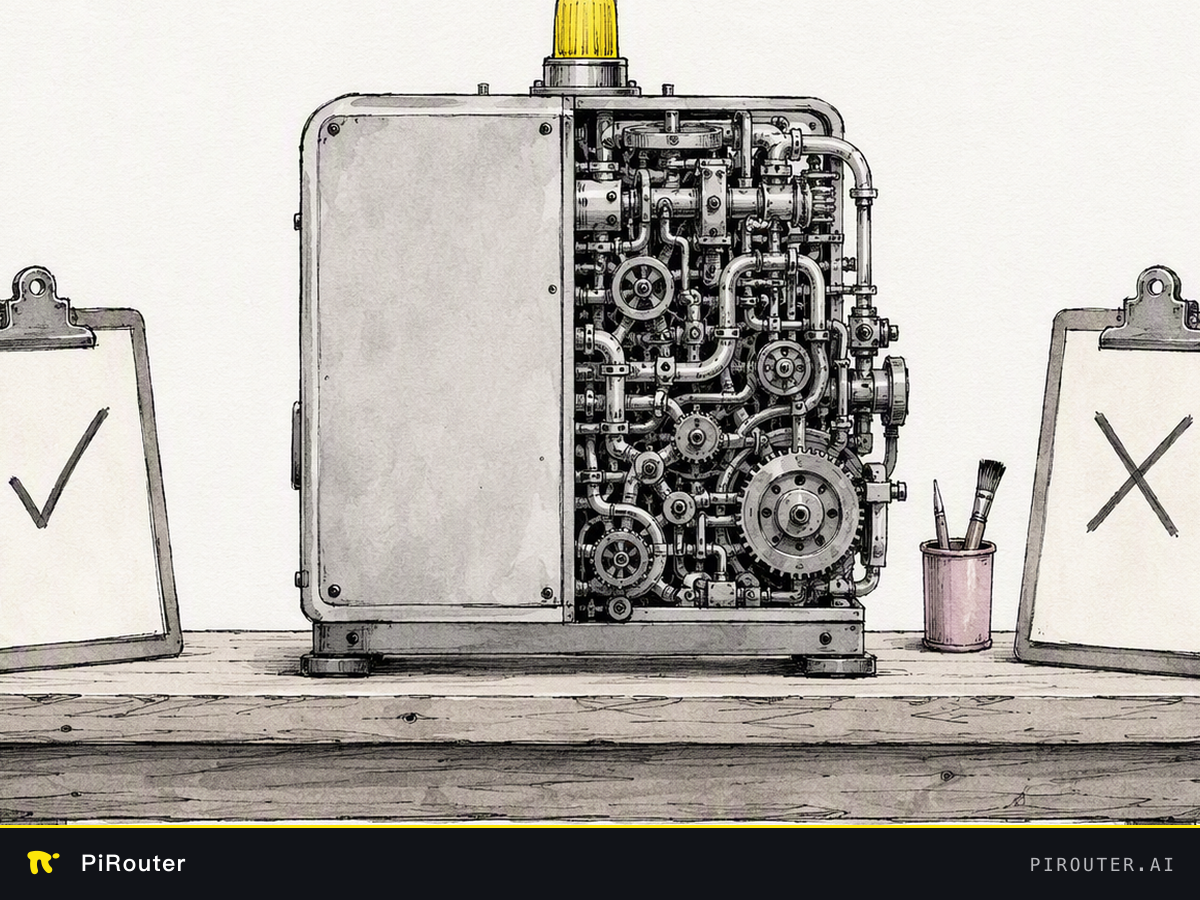
  12. One machine whose left half is a plain casing and right half a dense tangle of gears; a clipboard on each side, one marked with a check and one with a cross.

    Is GPT-6 Astra worth $10/$50? Two evals disagree, and both are right

    Linden Kern