
Claude Sonnet 5.5 on pirouter: exact model ID and $2/M standard input
Claude Sonnet 5.5 is available as anthropic/claude-sonnet-5.5. Check its standard rates and the separate five-minute and one-hour cache-write prices before your first request.
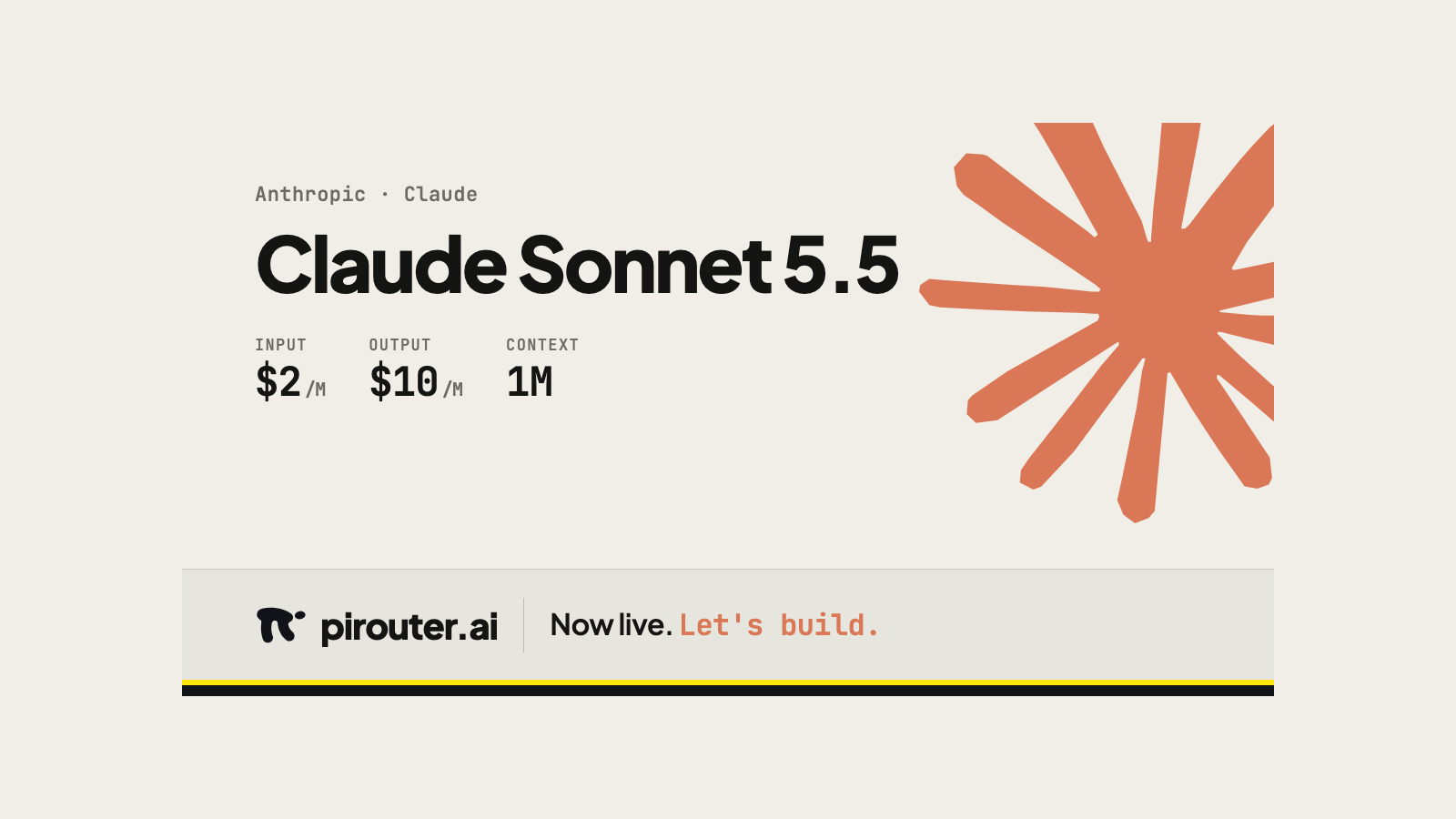
Claude Sonnet 5.5 is available on pirouter under anthropic/claude-sonnet-5.5. It went live here on September 29, 2026, one day after Anthropic’s announcement. The public catalog lists standard rates of $2 per million input tokens and $10 per million output tokens. You can check the ID and prices before making a paid request.
Onboarding included production requests and billing checks at launch; those historical checks do not establish current request health or universal protocol support.
Where can I find Claude Sonnet 5.5 on pirouter?
Start at the Claude Sonnet 5.5 model page. The same ID appears in the public model catalog and model detail record. If you already have a pirouter API key, select anthropic/claude-sonnet-5.5 where your client sets the model identifier. If not, sign in to create a key, then use the SDK integration guide and authentication guide for your request path.
Keep the prefix. Anthropic’s own API calls the model claude-sonnet-5-5; the pirouter catalog uses anthropic/claude-sonnet-5.5. Copy the ID from the catalog when routing through pirouter rather than silently assuming the two identifiers are interchangeable. You can inspect its current catalog record without making a paid inference request.
The catalog declares text, image, and file input and text output. That listing tells you what the model record advertises; it is not a certification that every media type, tool call, or structured-output setting behaves identically through every client protocol. Pick the request format your application actually uses, then test its required parameters before moving production traffic.
What are the standard token rates and limits?
The public detail record lists the following USD per million tokens:
| Charge | Standard rate |
|---|---|
| Ordinary input | $2.00 |
| Output, including billed reasoning | $10.00 |
| Cache read | $0.20 |
| Five-minute cache write | $2.50 |
| One-hour cache write | $4.00 |
A cache read reuses a previously stored prefix; a cache write stores one. The two write prices correspond to distinct retention periods, not interchangeable discounts. Neither is ordinary input. Whether your workflow actually gets cache hits depends on how its prompts and client are configured. Read the usage and billed categories of your own requests before treating the cache-read price as the cost of all input. The displayed rates are the catalog’s standard rates as checked on October 1; this notice does not quote a promotion, an expiry date, or a customer-specific discount.
The catalog declares a 1,000,000-token context window and a 128,000-token maximum output. These are catalog ceilings, not a recommendation to fill both on every call. A bigger context can also mean more input, cache writes, and repeated reads in a long agent session. A model’s price per token and your cost to finish a job answer different questions.
When should I try Sonnet 5.5 instead of another model?
Anthropic positions Sonnet 5.5 for everyday and clearly specified work, including routine coding fixes and creating documents. That is vendor positioning, not a claim that pirouter independently reproduced Anthropic’s benchmark results. It gives a sensible starting set of tasks: changes with tests you can run, extraction with a schema you can validate, or drafts with an acceptance rubric. For an open-ended problem where the first answer often fails review, test a stronger configuration rather than choosing from the price sheet alone.
Effort is part of that configuration. Anthropic’s effort guide says Sonnet 5.5 defaults to high on the Claude API and that effort levels were recalibrated relative to Sonnet 5. The pirouter catalog lists supported effort values, but a catalog field alone cannot prove your precise protocol-and-parameter combination has been exercised. Fix a quality bar, record the effort used, and compare the total cost of accepted work, including retries. A cheap call that cannot complete the task is not a cheaper task.
The vendor’s “up to 30% lower task cost” claim concerns its own evaluations, not our onboarding measurement or a guaranteed discount on every job. For now, the practical path is simple: open the Sonnet 5.5 model page, copy the exact catalog ID, and try a small, verifiable slice of your own workload.