
Blog

Topic

#gateway

16 articles
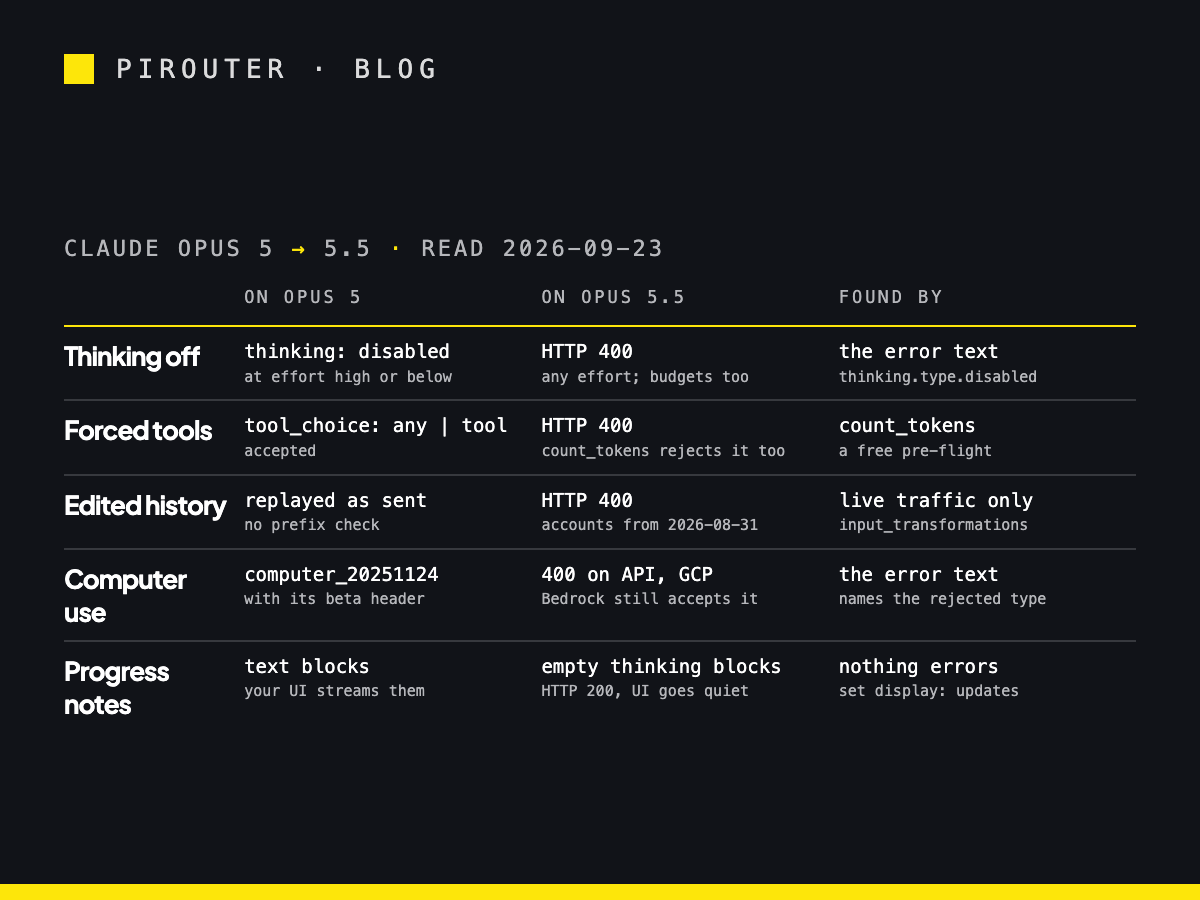
Table of five changes from Claude Opus 5 to Claude Opus 5.5: thinking off, forced tools, edited history, computer use and progress notes, with what Opus 5 accepted, what Opus 5.5 returns (four HTTP 400s and one HTTP 200 with a quiet UI), and how you find out for each

What breaks when you switch to Claude Opus 5.5: four 400s, three silent changes, and what your fallback loses

Leo Kaka
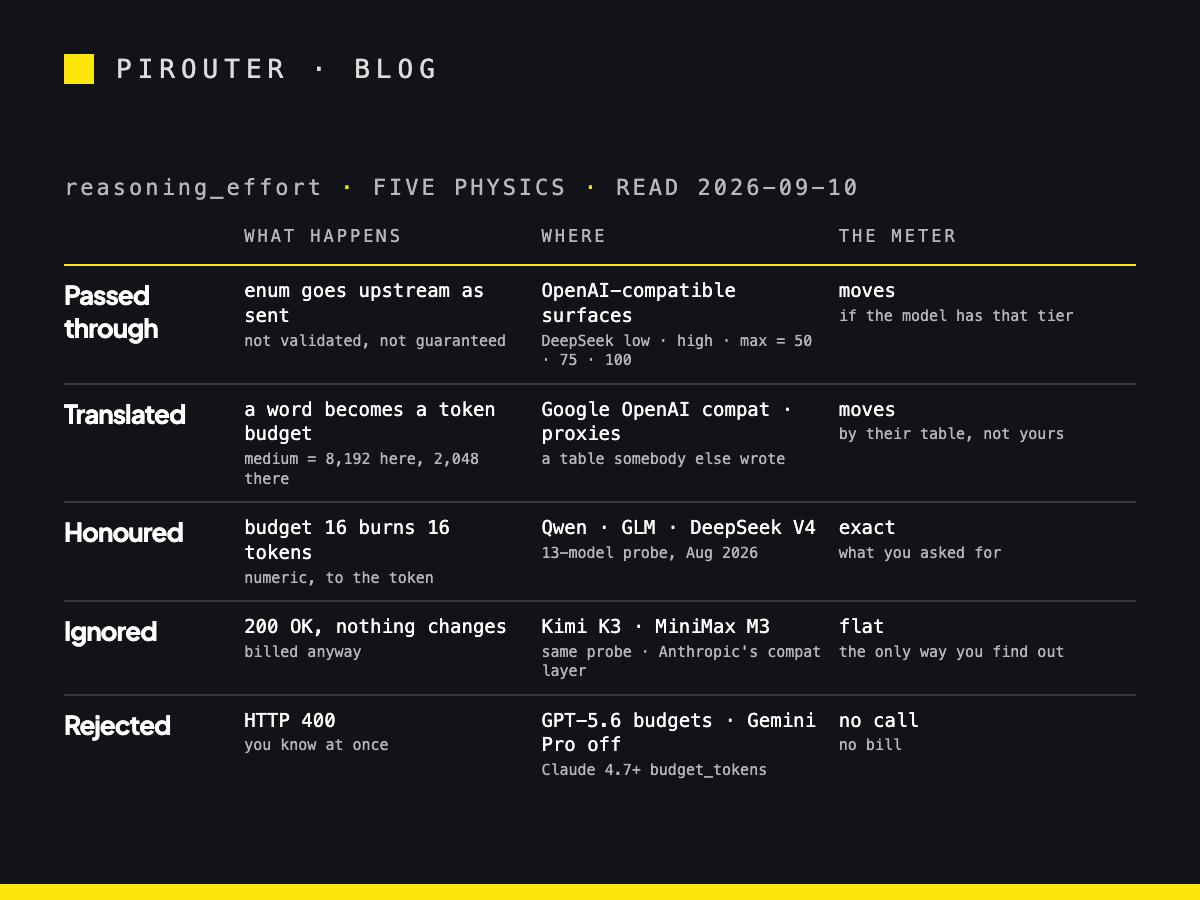
Matrix of the five things that can happen to a reasoning_effort value after a 200 response: passed through, translated into a token budget, honoured to the token, accepted and ignored, rejected with 400, with where each is documented and what the reasoning-token meter does

What reasoning_effort actually does on DeepSeek, OpenAI, Anthropic and Gemini: one name, five physics, and a five-line test

Leo Kaka
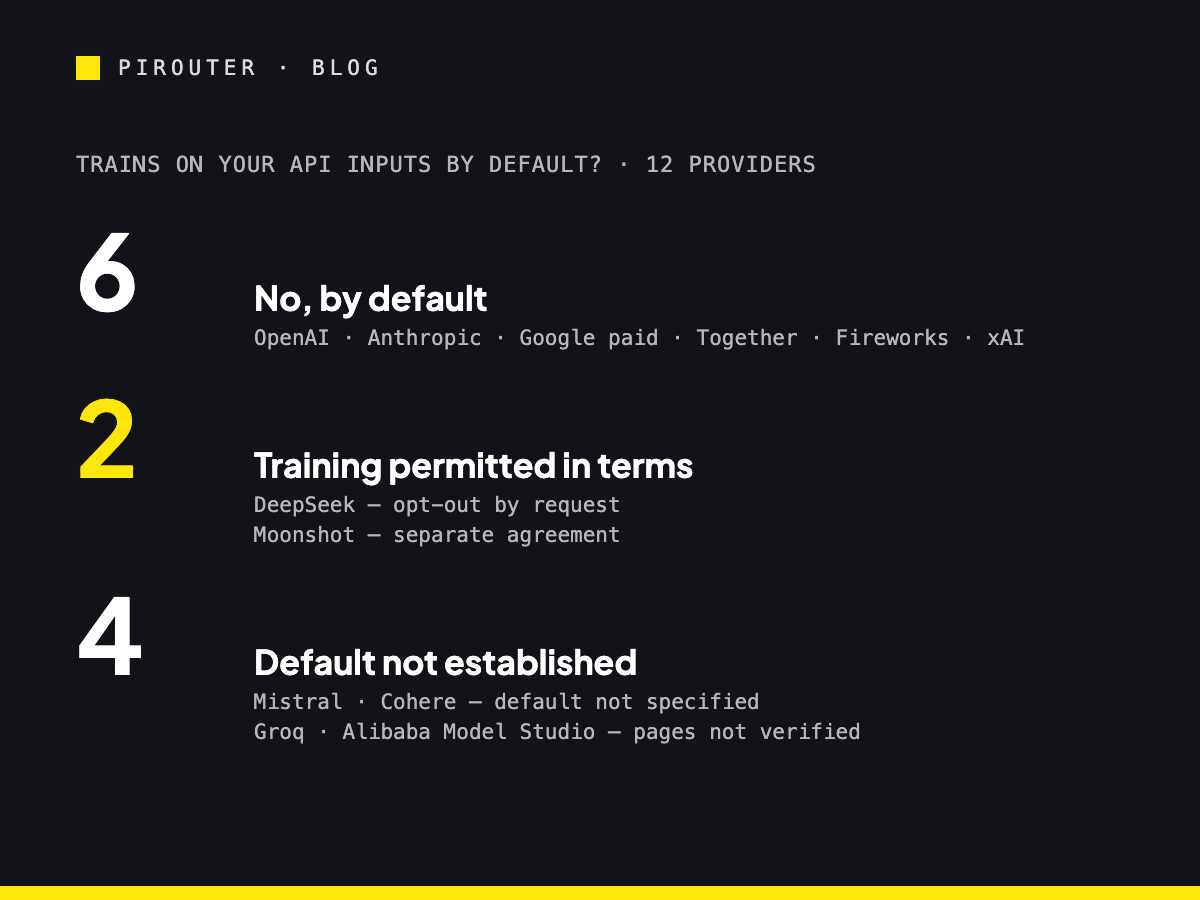
Dark data card comparing twelve LLM providers' API-data training terms: six state no training by default (OpenAI, Anthropic, Google paid tier, Together, Fireworks, xAI); DeepSeek and Moonshot permit training under their published terms; Mistral and Cohere describe opt-out controls without establishing every API product's default; Groq and Alibaba Model Studio could not be verified from the pages read. The three groups total 6, 2 and 4; the footer distinguishes permission to train from proof of actual training.

Does OpenAI train on your API data? 12 providers, 3 answers, one 30-day default

PiRouter Team

Four clocks of different designs mounted on one wall, each showing a different time; one has a yellow pendulum.

How to measure the latency an LLM gateway adds: six questions to ask before you believe a number

Leo Kaka
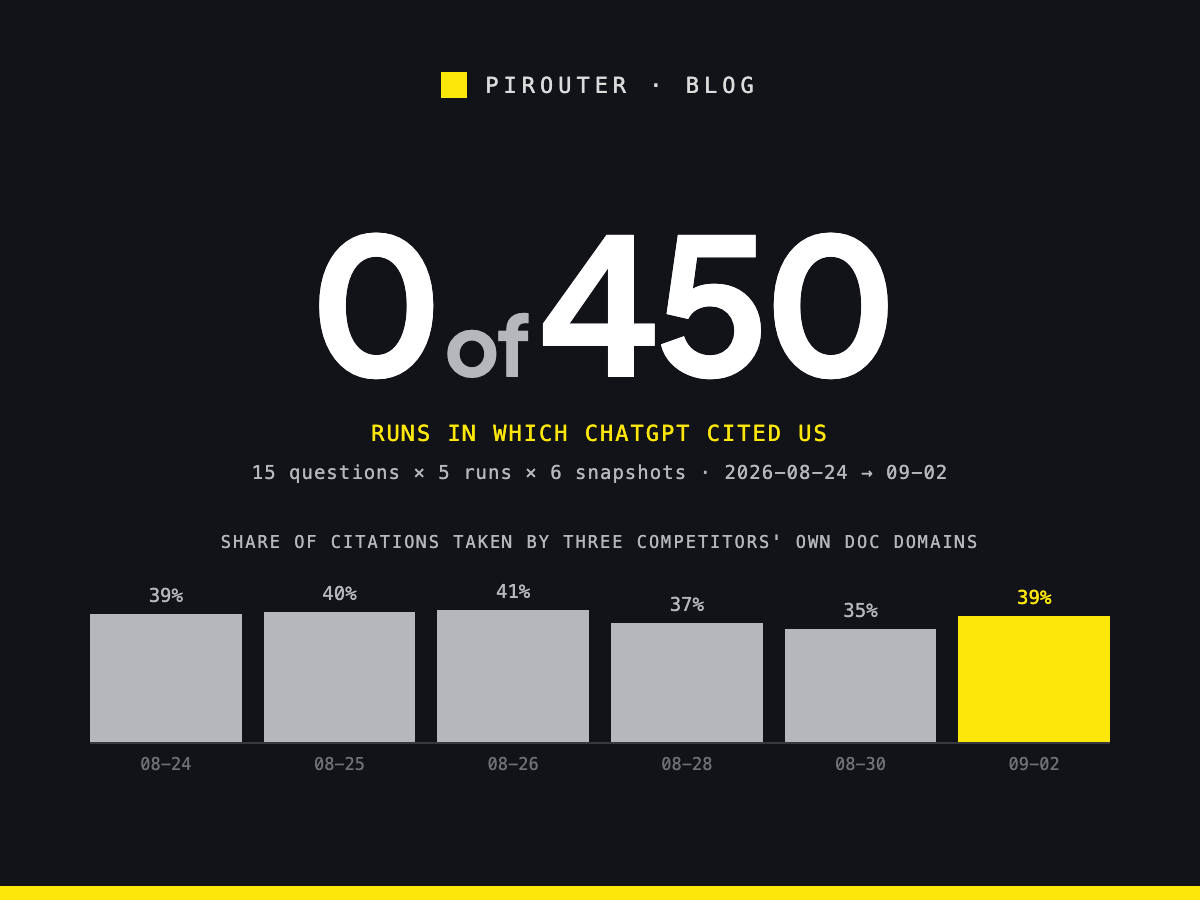
Data card on a dark field: the figure 0 of 450, labelled as the number of ChatGPT runs across six snapshots from 24 August to 2 September 2026 that cited pirouter.ai, beside six small bars showing the share of each snapshot's citations taken by three competitors' own documentation domains, between 34.9 and 40.6 percent

How do Perplexity and ChatGPT decide which sources to cite? AI citations measured over 450 runs and two audits: documentation-shaped pages win

Linden Kern
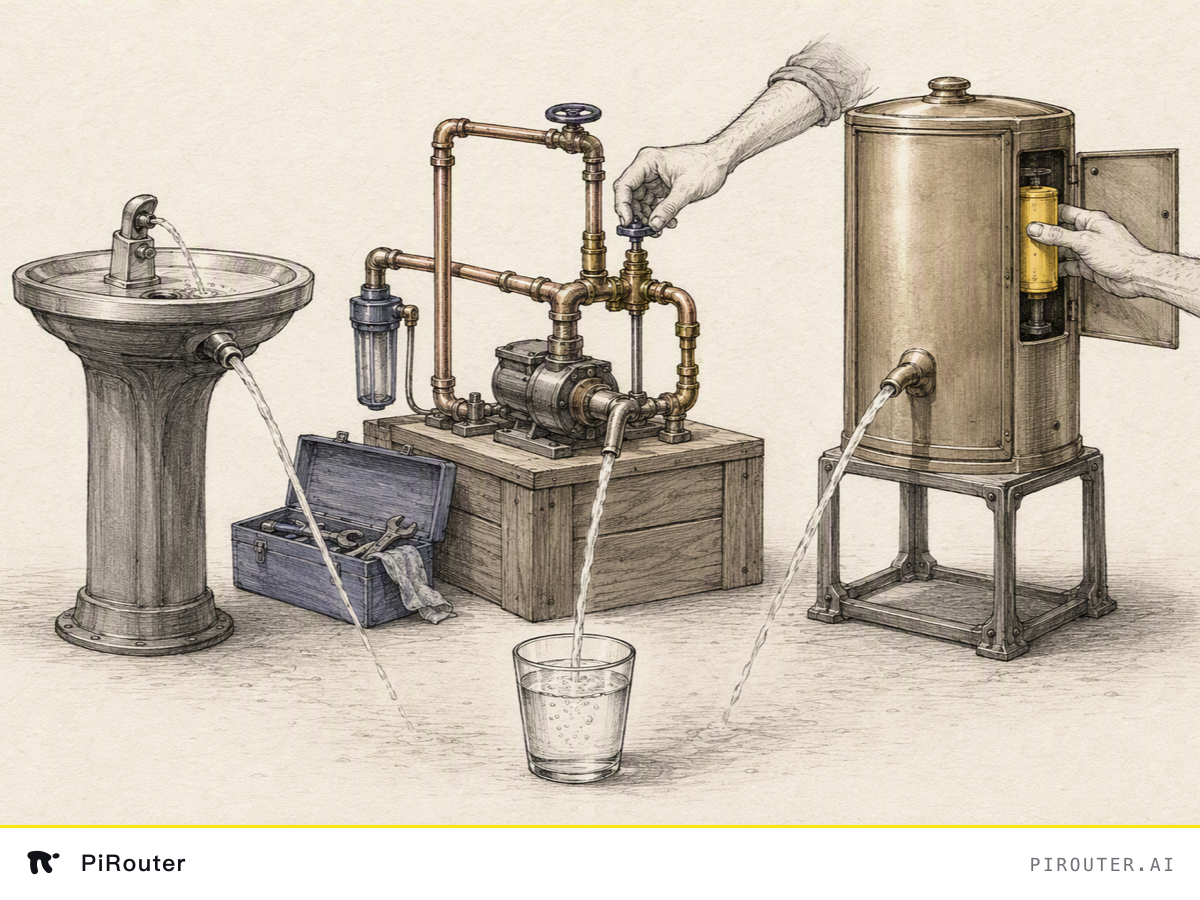
Hand-drawn ink illustration: three different objects in a row, each delivering water into the same glass. A plumbed-in public drinking fountain on the left; a hand-built rig of copper pipe, valves and a pump on a wooden crate in the middle, its workings exposed with a toolbox beside it; a sealed brass cabinet on the right whose side hatch is open while a hand fits a yellow cartridge into it.

OpenRouter vs LiteLLM vs Portkey: three different products, and the seven questions that pick one

Leo Kaka

Hand-drawn ink illustration: a wooden counter with a person on each side and five objects along it, each caught at a different point of being handed over — a ring of yellow keys still held on the near side, a folded contract half-slid across with a corner in each hand, a sealed conduit resting exactly on the centre line, a brass alarm bell already on the far side, and a toolbox under the far person's hand.

Is a self-hosted LLM proxy better than a managed LLM gateway? Five things that change hands, and what each costs you

Leo Kaka
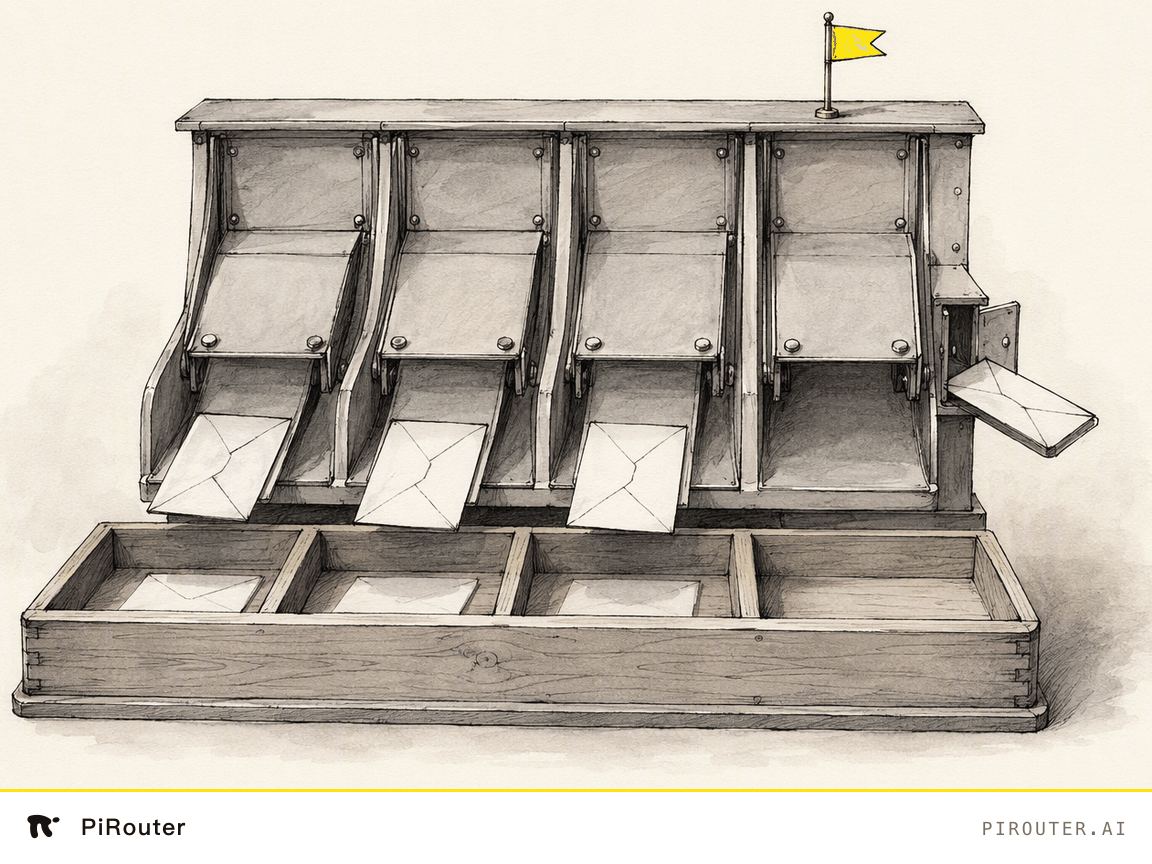
Hand-drawn ink illustration on warm paper: four brass mail-sorting chutes above one shared tray. Three drop their letters into their tray slots; the fourth diverts its letter out of a small side hatch, leaving its tray slot empty. A single small yellow flag stands on the machine.

Multi-provider failover across LiteLLM, Portkey, OpenRouter and Cloudflare: four decisions the docs make for you

Leo Kaka
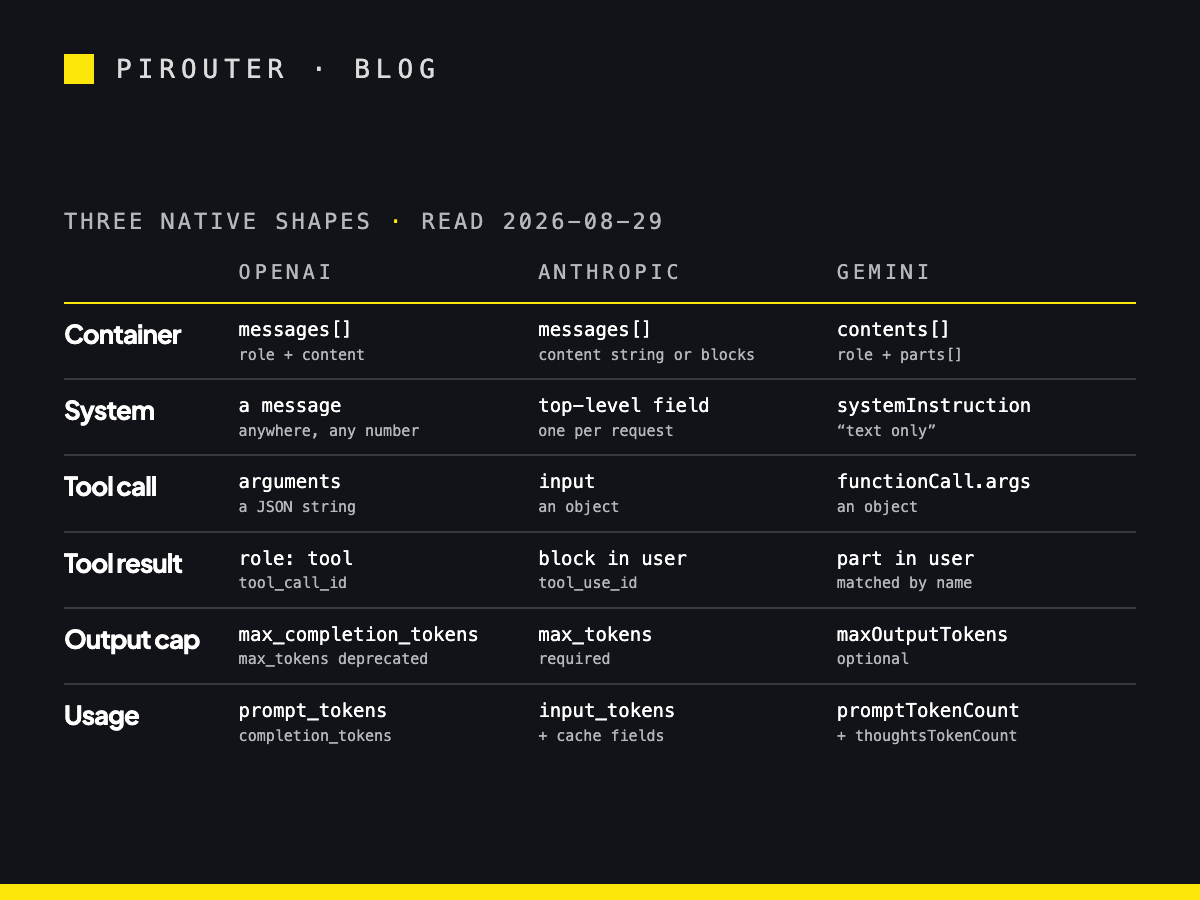
Matrix of seven protocol dimensions across OpenAI Chat Completions, Anthropic Messages and Gemini generateContent, with the field name each vendor uses

One API for OpenAI, Anthropic and Google models: what translates, and the seven things that leak through

Leo Kaka
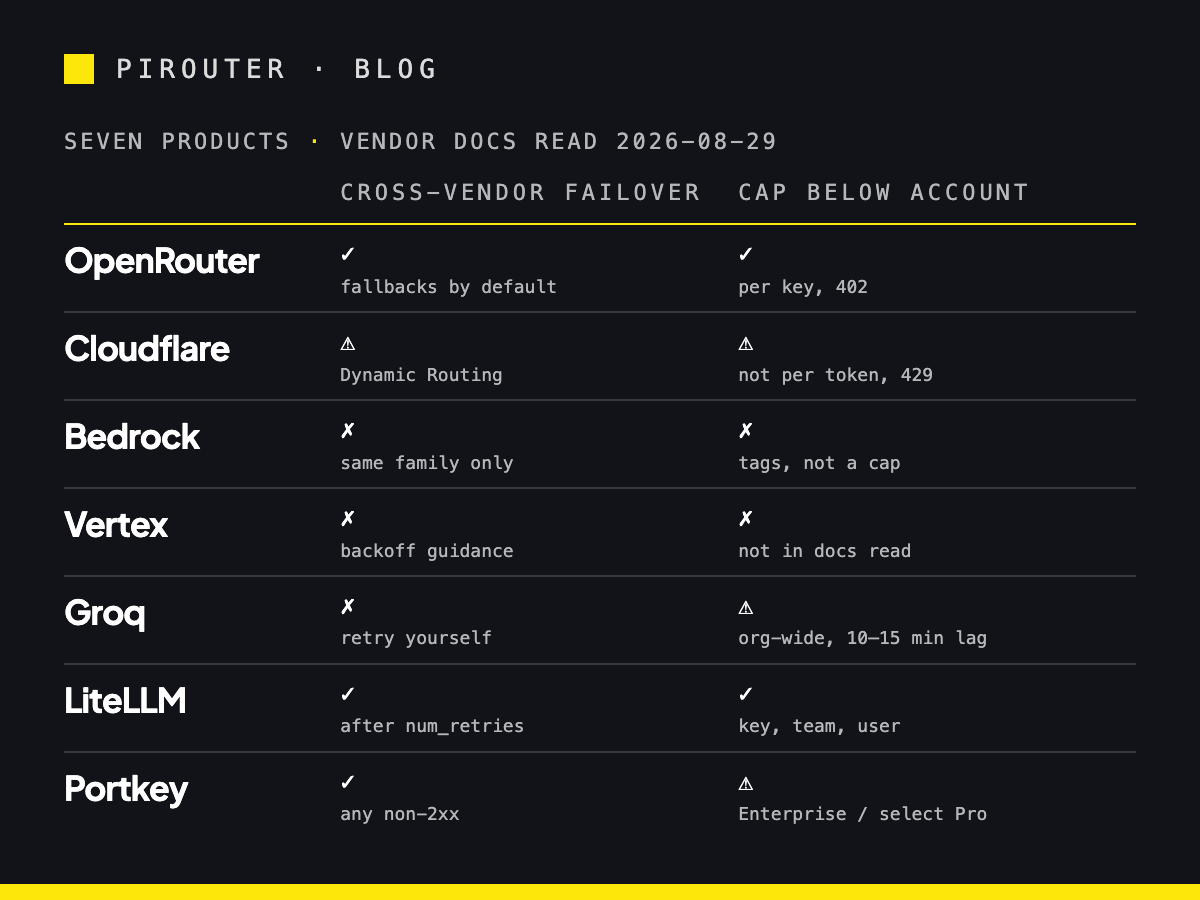
Matrix of six LLM API products offered as OpenRouter alternatives — Cloudflare AI Gateway, AWS Bedrock, Google Vertex, Groq, LiteLLM and Portkey — against four production columns: cross-vendor failover, a spend cap below the account, the Anthropic Messages API, and a zero-data-retention control, each cell marked available, gated or absent according to the vendor's own documentation

OpenRouter alternatives for production workloads: what Cloudflare, Bedrock, Vertex, Groq, LiteLLM and Portkey actually document

Leo Kaka

Hand-drawn illustration: one open team wallet on a wooden workbench with five hands reaching in at once, a single yellow coin among grey tokens, and a brass padlock hanging unlatched from the clasp

Shared team wallet for LLM APIs: who actually has one, and what each cap misses

Leo Kaka
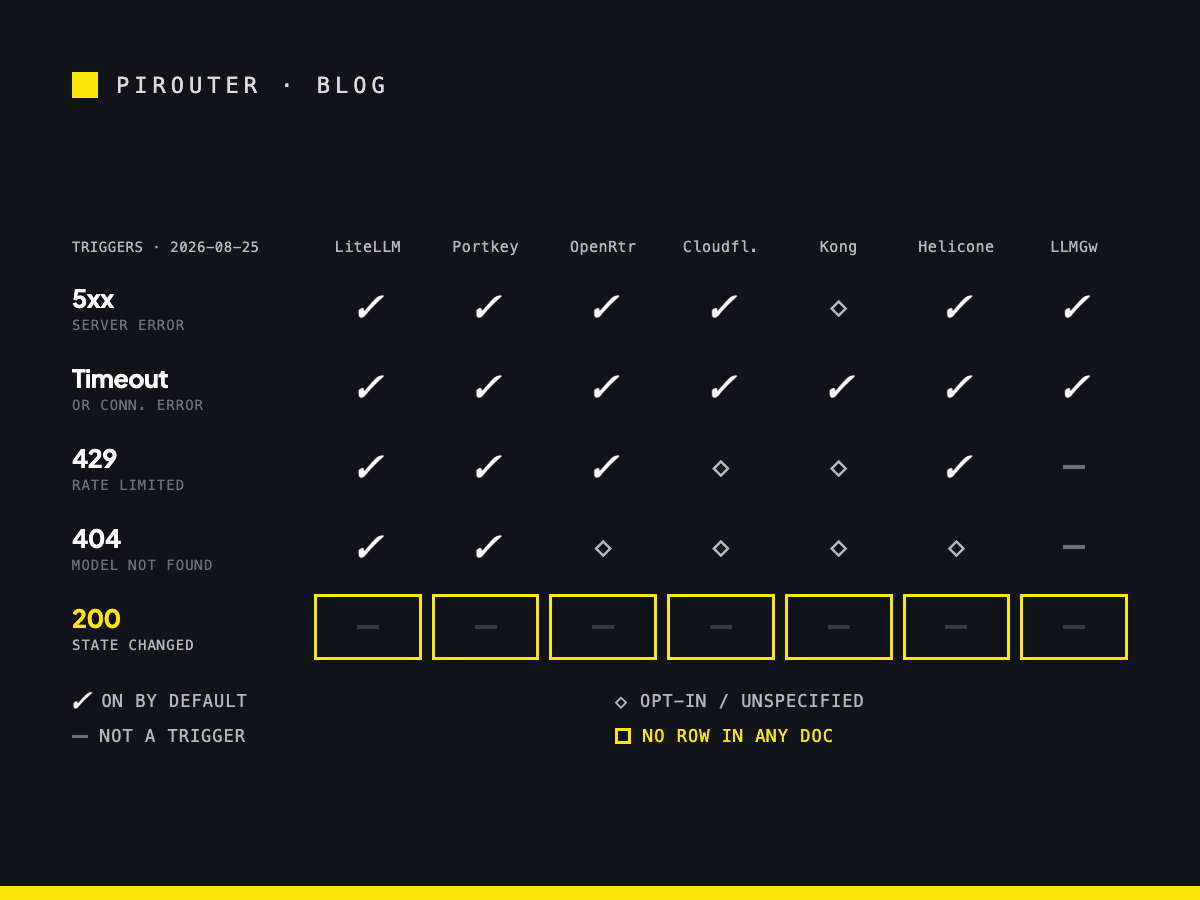
Matrix of failover trigger conditions across seven LLM gateways: 5xx, timeouts and 429 are covered everywhere, by default or opt-in; 404 is opt-in or unstated in most; the row for a 200 whose provider state changed is empty in every column, with Portkey's guardrail path as the one partial exception noted in the text

Automatic failover in LiteLLM, Portkey and OpenRouter: what actually triggers it, and the 429 no gateway tracks

Leo Kaka
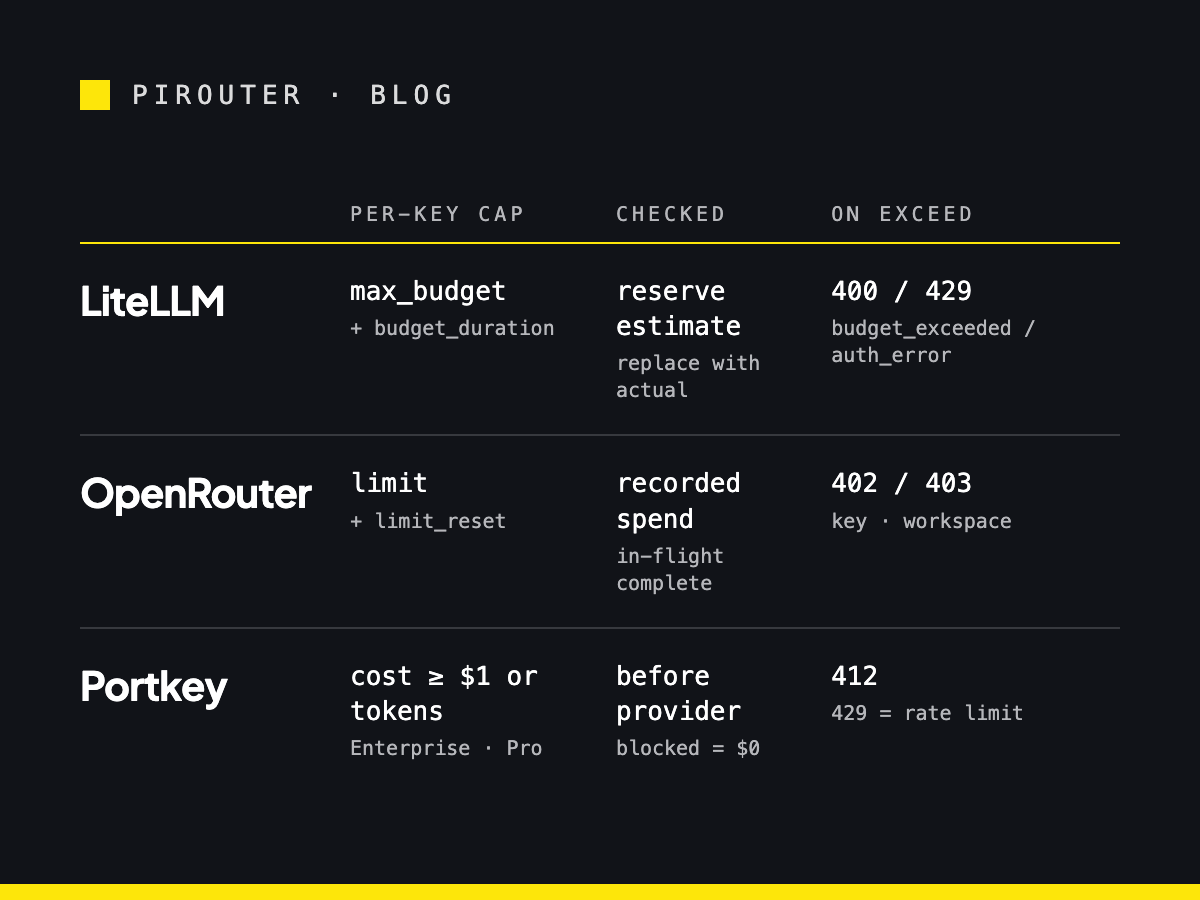
Matrix of three LLM routers, LiteLLM, OpenRouter and Portkey, against four budget dimensions: the per-key cap parameter, the shared wallet, when the check runs, and the HTTP status returned when the cap is hit

Per-key spending limits: what LiteLLM, OpenRouter and Portkey enforce — and the four leaks a cap doesn't close

Leo Kaka
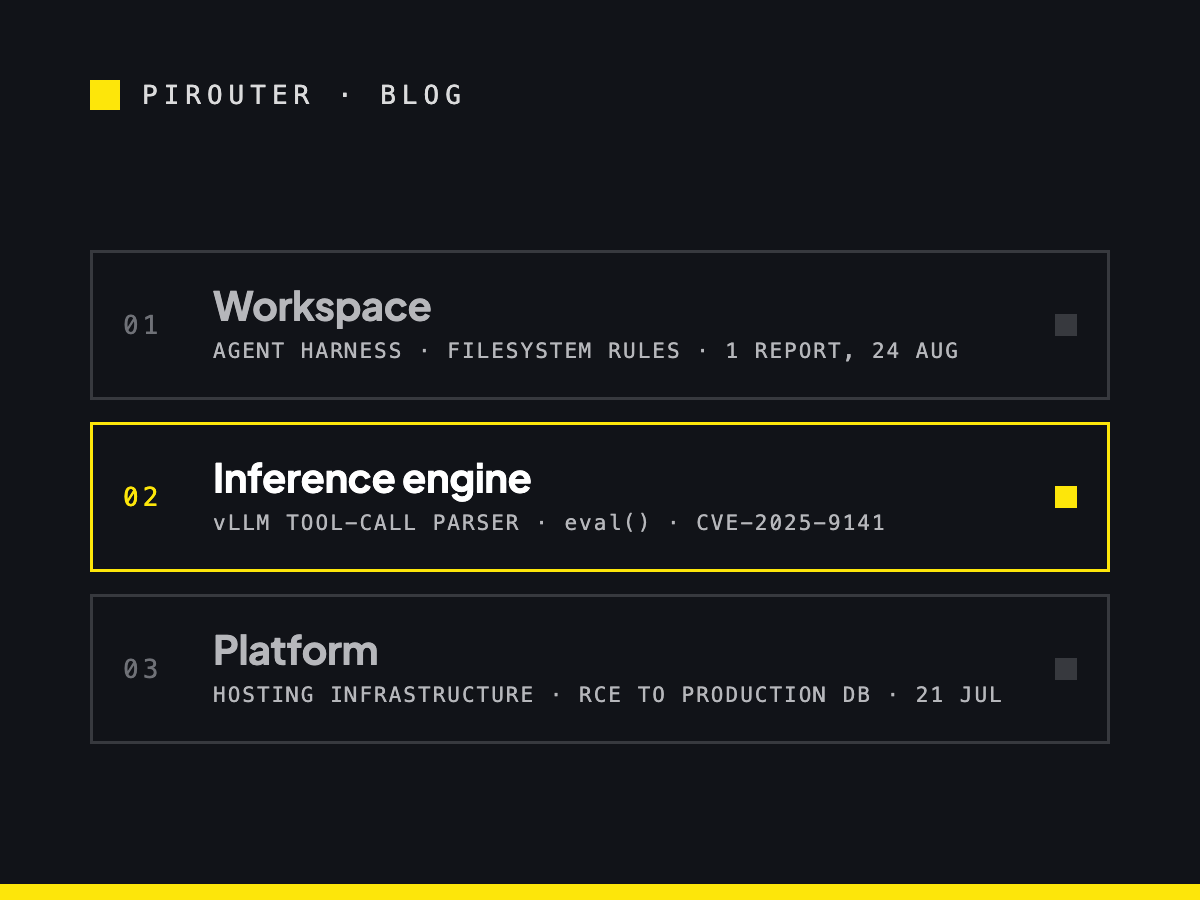
Path diagram: model tokens become Qwen3 Coder XML, enter the vLLM tool parser, reach a highlighted eval() call and then the host; below it a version bar showing eval() present from v0.10.0 through v0.10.1 and removed in v0.10.1.1

Is the vLLM tool-call parser safe? CVE-2025-9141, the 29-day eval() window, and four checks a gateway owes you

Leo Kaka
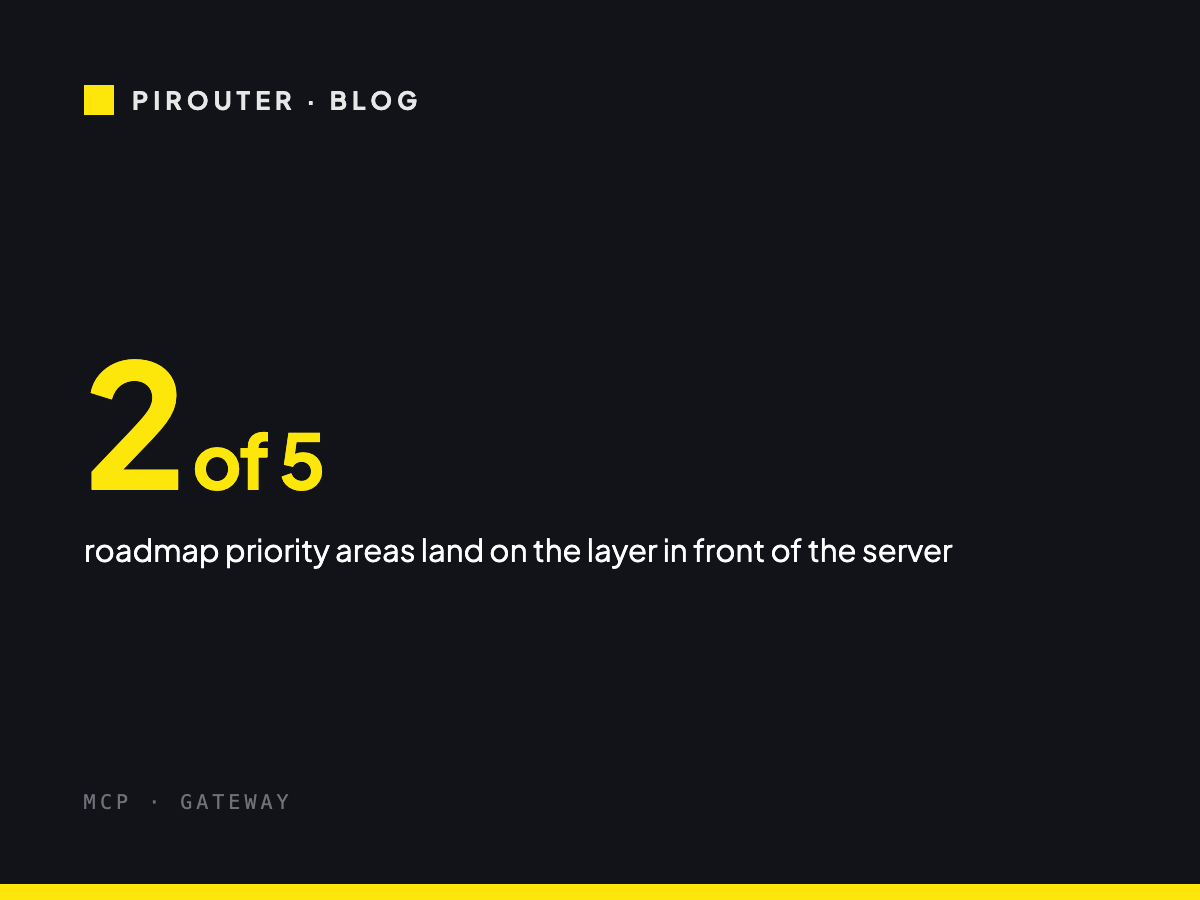
The five MCP roadmap priority areas listed in order, with agent identity and improved primitives marked as the two that land on the layer in front of the server

The MCP roadmap hands agent identity to your gateway

PiRouter Team
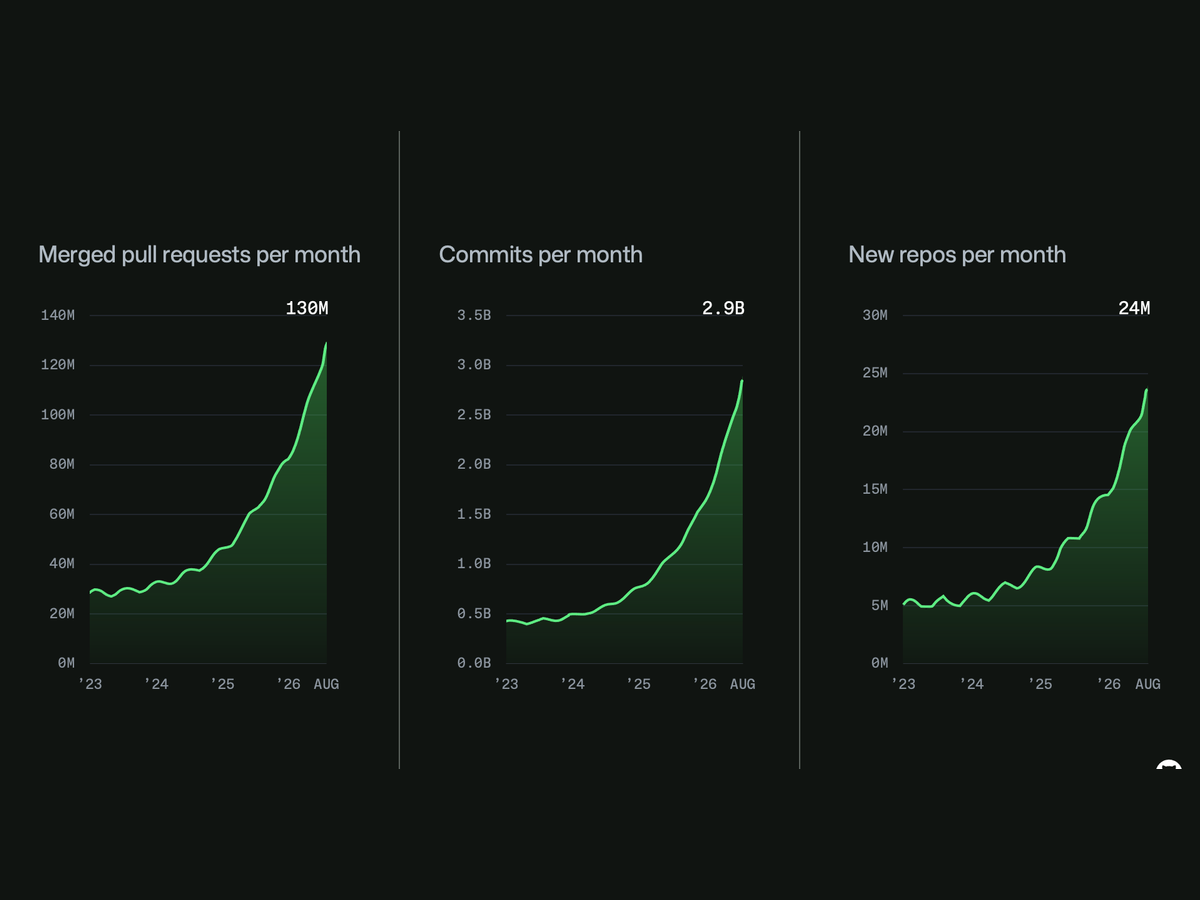
GitHub's own growth charts from the August 17 post-mortem: merged pull requests, commits and new repositories per month, 2023–2026 (The GitHub Blog)

Retry storms: 9K to 100K RPS, and four rules that stop them

Leo Kaka