
GPT-6.1 Sol on pirouter: $2/M input and a listed long-context tier
Use openai/gpt-6.1-sol on pirouter. Check the standard rates and the higher long-context tier before sending a large prompt; the exact 272K boundary and settlement need separate verification.
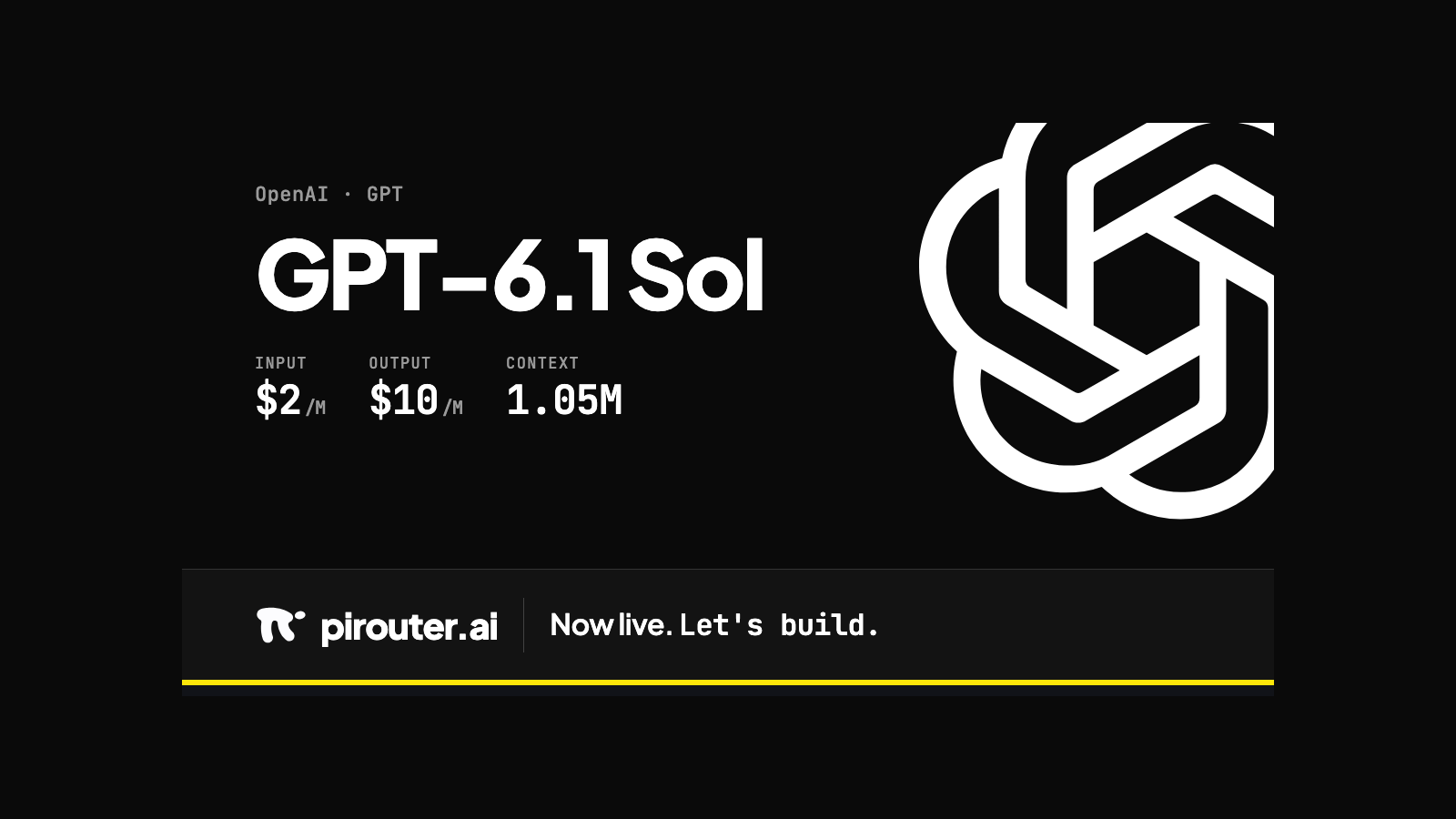
GPT-6.1 Sol is available on pirouter under openai/gpt-6.1-sol. It went live here on September 30, 2026, after the vendor’s September 29 announcement. The public catalog lists standard rates of $2 per million input tokens and $10 per million output tokens, with a higher tier for long prompts. Check the ID and listed rates without making a paid inference request.
Onboarding included production requests and billing checks at launch; those historical checks do not establish current request health or universal protocol support.
Where do I find GPT-6.1 Sol on pirouter?
Open the GPT-6.1 Sol model page or its public catalog detail. Set your request’s model field to openai/gpt-6.1-sol when using pirouter. The vendor’s direct API documents gpt-6.1-sol without the provider prefix; do not copy that bare value into an integration that expects a pirouter catalog ID.
If you need a key, sign in to create one. Follow the SDK integration guide and authentication guide for your selected request path. Start with one representative prompt, check its output and usage, and then move a small slice of your application. The public model record declares text, image, and file input with text output, but a declaration of modalities is not proof that every combination of formats and tools has been exercised through every client surface.
How much do standard and long-context requests cost?
As checked on October 1, the pirouter model detail displays these standard USD rates per million tokens:
| Billed category | Standard rate |
|---|---|
| Ordinary input | $2.00 |
| Output, including billed reasoning | $10.00 |
| Cache read | $0.10 |
| Cache write | $2.50 |
A cache read is reuse of previously stored prompt material; a cache write stores material for future reuse. A low cache-read rate is not a 95% discount on every request. Output and new prompt material still have their own charges. The table is standard catalog pricing, not a promise about an individual account’s effective bill or a time-limited promotion.
Long prompts need a second look. The public pirouter model detail lists a higher tier around 272,000 input tokens: $4 per million ordinary input tokens, $0.20 per million cached reads, $5 per million cache writes, and $15 per million output tokens. Separately, OpenAI’s model documentation says its own requests with more than 272,000 input tokens are repriced for the whole request, not just the excess tokens. That vendor billing rule cannot, by itself, establish how pirouter settles every request. Our public listing states the higher tier, so budget for that tier when clearly above the threshold; the exact 272,000-token equality case and actual pirouter settlement behavior have not been verified here. Check the current model page and your resulting bill before relying on a boundary-sensitive estimate.
The catalog declares a 1,050,000-token context window and a 128,000-token maximum output. These are listed ceilings, not a recommendation to build every request at their limits. In a long-running workflow, repeated context and output can dominate the invoice even when a prompt is far below the maximum.
Which request path and tasks should I try first?
OpenAI’s model documentation describes GPT-6.1 Sol as a lower-cost option for demanding work and documents tools on the Responses surface. Its documentation does not promise the same tool behavior on Chat Completions. Our catalog lists supported parameters at a model level; that field does not certify every combination of parameters on every pirouter protocol path. If your application depends on tools or structured output (a response constrained to a specified JSON shape), use the appropriate documented request format and test the exact shape you intend to ship. Do not infer today’s compatibility from a first-day failure or from a successful request using a different endpoint.
The easiest initial evaluation is a defined task with a clear acceptance test: a bounded code change, a document extraction checked against expected fields, or an answer your team can review. Measure accepted completions and retries alongside billed categories. Neither a model’s list price nor a headline benchmark guarantees a cheaper completed job for your workload; the model’s lower output price than a larger alternative is only one term in the calculation.
For the ID and current public rates, go to the GPT-6.1 Sol model page. Copy the prefixed ID, verify the relevant price tier, and test the request path your product will actually use.