
HY4 flash pricing: the low API rates are list prices, with 50% off until November 30
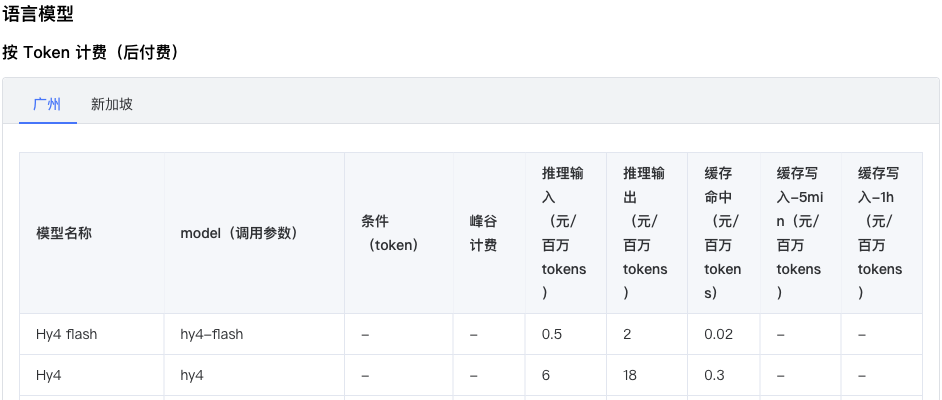
Tencent Cloud's Guangzhou TokenHub rate card lists HY4 flash at ¥0.50 input, ¥2.00 output and ¥0.02 cached input per million tokens. A separate 50% promotion ends November 30 at 12:00 Beijing time; WorkBuddy's free trial is not a free API plan.

Cover: AI-generated conceptual image. The dial does not depict official prices or a measured discount.
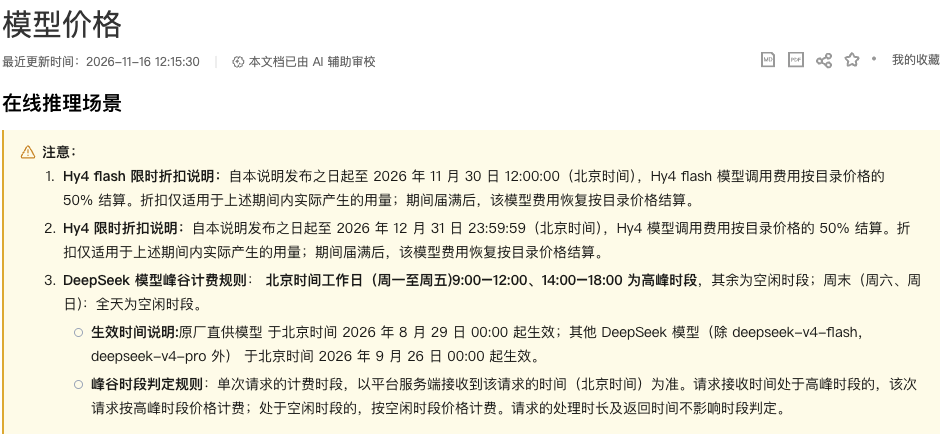
HY4 flash’s advertised API prices are the published TokenHub list rates, not prices with the November promotion already applied. The China-site Guangzhou CNY rate card lists ¥0.50 per million ordinary input tokens, ¥2.00 per million output tokens and ¥0.02 per million cache-hit input tokens; qualifying TokenHub usage is billed at half the list rate until November 30, 2026, at 12:00 Beijing time. Tencent also says the model is temporarily free in WorkBuddy, but that is a separate product experience, not a promise of free or unlimited API calls (Tencent Cloud TokenHub model pricing; Tencent HY4 flash announcement).
That distinction is the useful part of this launch for a developer. You can try a low-cost model while the promotion runs, but a pilot budget must survive the return to list pricing. The cache line is cheaper only for input actually recorded as a cache hit, and a tool’s free-use window tells you little about your API bill. Read the three as separate statements before picking a model for a recurring workflow.
HY4 flash has a low published rate card, plus a temporary billing discount
Tencent announced HY4 flash on November 16 as a smaller-active-parameter addition to its Hy family. It describes 224 billion total parameters, including 64 billion Engram parameters, with 12 billion active parameters, multimodal input and a context window of up to one million tokens (Tencent HY4 flash announcement). These are reasons to put a candidate on a test list, not evidence that a particular million-token document will be handled well or that 12B active parameters match some larger model’s output quality.
The announcement quotes approximately US$0.070 input, US$0.281 output and US$0.003 cached input per million tokens. Those are Tencent’s approximate dollar figures, not an exchange-rate conversion we have independently recalculated. For this article’s billing arithmetic, use the Guangzhou region on Tencent Cloud’s China-site TokenHub rate card, where the service actually displays the three CNY categories. This region-specific example is not a claim that every region, account or plan has identical terms. The product page does not label its ¥0.50/¥2.00/¥0.02 row as a second, already-discounted rate. The model pricing and discount terms separately say that promotional HY4 flash use is settled at 50% of the directory price.
That is why a screenshot of the rate card and the phrase “50% off” must not be silently collapsed into one set of numbers. If ¥0.50 were treated as the discounted input price and halved again in a comparison, the supposed saving would be imaginary. Conversely, quoting the derived ¥0.25 as the permanent input rate would understate the cost after the promotion.
| HY4 flash, TokenHub China site / Guangzhou, CNY per 1M tokens | Published directory rate | At 50% off, calculated from directory rate |
|---|---|---|
| Ordinary input | ¥0.50 | ¥0.25 |
| Output | ¥2.00 | ¥1.00 |
| Cache-hit input | ¥0.02 | ¥0.01 |
The right column is our arithmetic, not a separate set of prices printed in the official table. The stated promotion covers eligible use during its period and ends at 12:00:00 Beijing time on November 30 (Tencent Cloud TokenHub model pricing and discount). Do not take “through November 30” to mean until local midnight wherever you are. For scheduling and actual charges, check the current provider terms and the bill; a price page can change after publication. Nor should you take rates from a different commercial surface: Tencent’s international Personal Token Plan offer speaks in credits. Those credits are not the CNY prices in this TokenHub table, and this calculation does not convert them into money.
Under that China-site Guangzhou tariff, consider a hypothetical series of requests whose aggregate usage is one million ordinary input tokens and 200,000 output tokens, with no cache hits. At the published rates the arithmetic is ¥0.50 for input plus 0.2 × ¥2.00 for output, or ¥0.90. At half price, assuming all of that usage qualifies, it becomes ¥0.45. These are tariff-only illustrations, not a recorded HY4 flash invoice, an estimate of taxes or a promise about fees beyond the listed token categories. It matters that output is charged separately: a model with cheap input can still generate a bill dominated by long answers, tool chatter or retries.
HY4 flash’s ¥0.02 cache-hit line is conditional, not its input price
The largest number-to-number gap on the rate card is between ordinary input at ¥0.50 and cache-hit input at ¥0.02 per million. That does not mean every prompt enjoys the latter rate. The table names a cache hit category. Whether a request actually qualifies depends on the service’s caching behavior and the workload’s reuse; the rate card by itself does not establish that every repeated prompt will hit. Its cache-write fields show a dash rather than an affirmative price or entitlement, so we should not describe cache creation as free, automatic or available on particular conditions without further evidence (Tencent Cloud TokenHub model pricing).
Hold the total token mix constant to see why the distinction matters. The previous example uses one million input and 200,000 output tokens. Now assume half the input qualifies as cache hits: 500,000 ordinary input at the list rate costs ¥0.25; 500,000 cache-hit input costs ¥0.01; output remains ¥0.40. That is ¥0.66 at list rates, or ¥0.33 under the same assumed half-price promotion. The ¥0.24 list-rate difference from the all-ordinary ¥0.90 case is conditional on the stated hit mix. It is not an observed saving from a real API call, and it says nothing about any unverified write mechanics or other charges.
A one-off document may have little eligible reuse. A workflow that repeatedly sends a stable body of context might have more, but you need actual usage categories to know. Count ordinary input, cache-hit input and output separately, then apply the price for each category. The related explanation of why one nominal model price can produce different bills covers the broader accounting principle; it is not evidence that HY4 flash will achieve any particular cache-hit rate.
The same discipline applies when the promotional window closes. A budget sized to the assumed ¥0.33 promotional case becomes ¥0.66 under the list rate if the token mix stays identical. In practice the mix may change with prompts, context length, the provider’s cache behavior and output length. Keep the input assumptions in the spreadsheet rather than treating one favorable estimate as the unit cost of all future tasks.
WorkBuddy’s free HY4 flash access is not a free TokenHub API tier
Tencent says HY4 flash is available in TokenHub and WorkBuddy, among other products. The release announcement offers free access in WorkBuddy through November 30, and 50% off standard pricing via TokenHub. It does not publish a universal WorkBuddy daily quota, the account conditions for that free period, or a precise WorkBuddy closing hour. The 12:00 Beijing deadline above comes from TokenHub’s billing document; transferring it to the WorkBuddy offer would turn a documented API condition into an invented tool condition.
There is also a new-user trial allowance displayed on the TokenHub product page. It is a separate eligibility claim about new users, not a reason to mark every existing customer’s API request as free or to assume the allowance uses the same terms as WorkBuddy. If the trial matters to your purchase decision, check your account’s actual entitlement before forecasting a zero-cost pilot.
A November 16 iFanr hands-on report makes the distinction tangible. Its author used WorkBuddy to build an interactive 3D sailing-ship page, reporting roughly 30 minutes, around 149,000 tokens consumed and, separately, about four million cache-hit tokens. Those are the report’s separate usage figures, not a total with cache hits as its subset. The article puts the task at about ¥0.23 using API pricing as an estimate. That is useful as one reported workload shape, but it is not a paid TokenHub invoice. In the same report another model took roughly 90 minutes on the ship task, yet produced a more detailed result. Those observations do not show that every task will be faster or that equal-quality outputs will have that cost ratio.
Tencent’s own WorkIndex discussion cites a per-task cost of one-twentieth of Hy4 for its internal WorkBuddy-style evaluation. That is a vendor-run task comparison, not a claim that HY4 flash’s token price is one-twentieth of Hy4’s in every billing category. Artificial Watch’s independent editorial check makes the same distinction between per-task claims and per-token rates; it does not add an independent paid-API benchmark. An estimate from a tool task, an internal benchmark and a production bill are three different kinds of evidence.
When HY4 flash is worth piloting—and when the discount is not enough
A bounded trial makes sense if your work resembles the ordinary document, simple front-end or office-agent tasks Tencent says it targets, and you can check the result instead of just measuring its speed. Pick several representative tasks, preserve the prompts and tool permissions, and score whether the delivered artifact actually meets your acceptance criteria. Track elapsed time, retries, ordinary input, verified cache-hit input and output. Then calculate the same usage once at the promotion rate and once at the directory rate. A cheaper first run that needs several corrective turns may not be the cheaper completed task. Stop or fall back if the representative tasks miss your quality threshold, or if the cost per accepted deliverable—including retries, calculated at post-promotion list rates—exceeds your team’s existing budget or comparison baseline.
Do not design the pilot around the headline “over 150 tokens per second.” Tencent says that decoding figure follows optimizations including megakernel, 4-bit quantization and DFly, but the announcement does not specify the hardware, concurrent load or context conditions needed to reproduce it. The claim that reinforcement learning cuts average end-to-end task output tokens by 50% also lacks an explicit comparison baseline in that announcement. Neither figure is a guaranteed response time or a fixed reduction in your output bill.
There are equally clear reasons to defer. Tencent itself points users toward the more capable Hy4 for complex, long-horizon software engineering rather than treating HY4 flash as a replacement for all tasks (HY4 flash announcement). If your workload requires independently established quality parity, a known route through another distributor or locally inspectable Flash weights, this announcement does not supply those conditions. The named OpenRouter integration is described as coming soon, and HY4 flash’s open-source release is planned. Availability of a different Hy4 variant’s weights or ranking does not establish either condition for Flash.
The actionable decision is modest. Test against a small real workload if the published directory rate still fits your budget, your actual TokenHub account is eligible for the temporary offer and you can evaluate output quality. Otherwise wait for clearer usage and availability evidence. The promotion is a useful way to lower the cost of learning; it is not evidence that the price, the cache-hit ratio or the task result will hold after November 30.