
Cloudflare Search for Agents: What It Returns and Costs
Cloudflare’s new beta lets agents search public docs and retrieve Markdown. See what comes back, the Free crawl limit, and how billing works from December 1.

Cloudflare opened Search for Agents in beta on November 25, 2026, for all plans, including Free. Turn it on for a domain and agents can query that site at /.well-known/search for relevant Markdown excerpts, not an AI-generated answer. AI Search limits and pricing lists a December 1 billing start: the switch is available now, but indexing, storage, and searches have limits and can become billable.
What the Search for Agents switch turns on
Suppose an agent lands on your help center while looking for instructions on exporting a CSV. Converting the homepage into Markdown makes that page easier to read. It doesn’t tell the agent which page explains exports. Search for Agents gives the agent a way to look that up without already knowing the URL.
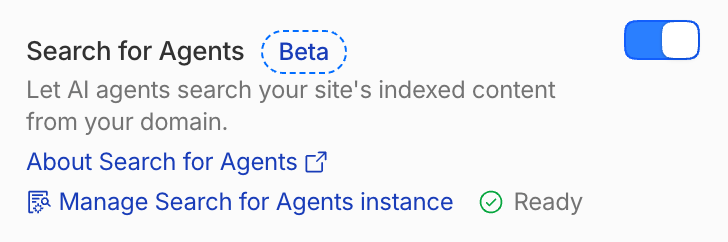
Website indexing was already part of AI Search. What’s new, as the Search for Agents launch announcement explains, is the integration: one switch creates an AI Search instance, starts crawling the site, and advertises a same-domain endpoint in the HTML metadata. If you also enable Markdown for Agents, that same discovery information appears in the Markdown response’s front matter. You don’t need Markdown for Agents to use the search endpoint.
On a domain already onboarded to Cloudflare, the switch lives in Overview → Quick Actions. Review the setup and price notice before confirming, then wait for indexing before interpreting your first search. The Search for Agents setup guide says the crawler discovers pages from sitemaps and links, leaves subdomains out by default, and defaults to a 24-hour sync interval. A manual published on a separate docs subdomain isn’t automatically part of the parent domain’s index.
What /.well-known/search returns
Once your own public docs are indexed, try a question with a known answer. Replace example.com with the domain you enabled:
curl --get 'https://example.com/.well-known/search' \
  --data-urlencode 'q=How do I export a CSV?'
The setup guide documents Markdown results with source references and relevance scores. The calling agent still has to choose the right excerpt and compose its answer. If the current export guide and an older guide both turn up, a high relevance score alone doesn’t tell you which instructions are correct. Check the returned source against the page you would send a customer.
A normal GET is enough for a first check. Cloudflare also documents the HTTP QUERY method for sending search text in the body. Neither method turns this endpoint into a chat API, and you don’t need to enable separate public REST or MCP endpoints to use it.
Free crawl limits and pricing from December 1
Prices checked November 26, 2026. The pricing page says AI Search starts billing on December 1, 2026. The included usage is per account per month, not per site or per search instance. The published rates for usage above it are:
| Meter | Included each month | Published overage rate |
|---|---|---|
| Base ingestion | 5 million tokens | $0.75 per million tokens |
| Storage | 10 GB-month | $2.00 per GB-month |
| Semantic queries | 1,000 | $0.75 per 1,000 semantic, vector, or hybrid queries |
| Full-text queries | 1,000 | $0.10 per 1,000 full-text queries |
These are AI Search allowances for a Workers Free or Workers Paid account, shared across its instances. Free allows up to 100 instances per account. Paid includes the first 5,000; to go beyond the default limit, request an increase. Each additional instance costs $0.10 per month. The pricing page doesn’t establish what happens to an individual Free account when its monthly usage allowance runs out; don’t assume it either stops or automatically incurs charges.
Search for Agents defaults to hybrid retrieval, so budget at the semantic/hybrid rate. For images and scanned documents processed with OCR, the extracted text counts toward base ingestion and as image-processing tokens. Image processing shares the 5-million-token ingestion allowance and has an additional published rate of $0.50 per million tokens. The example below assumes text only. It covers the AI Search bill, not the Workers subscription or a separate model call to generate an answer.
Take a hypothetical paid account with no other AI Search usage. If the meter counts 4,000 hybrid searches in a month, the 3,000 above the allowance add $2.25. If total ingestion hits 6 million tokens and storage comes to 11 GB-month, those overages add $0.75 and $2.00 respectively. That’s $5.00 in AI Search overage at the listed rates, before plan charges or taxes. A second site on the same account would draw from the same allowances.
Crawl throughput is a separate constraint. Workers Free tops out at 500 pages crawled per day, even though the Discover crawler has a 100,000-page per-crawl ceiling. If an important article is missing on day one, check the index’s coverage before deciding the search results are poor.
Start with a public docs pilot
Choose a domain that already contains only material you intend to make searchable. Wait for the first crawl, then check a handful of queries where you know the right source: an exact feature name, a natural-language how-to, and a question where only the current version’s instructions should count. Inspect the excerpts and links before judging what an agent writes from them. Track ingestion, stored content, and query volume at the account level before rolling out to more sites.
If the right pages rarely make it into the results, fix coverage before switching on another domain. If they’re there and agents can find the endpoint, you’ve verified the useful part of this release: your website can hand out relevant source passages without having to write the answer itself.
Cover illustration: Cloudflare’s Search for Agents launch announcement.