
Anthropic's IPO puts Claude's $81B run rate to the test
Anthropic has begun a proposed IPO roadshow. Reported realized revenue and an $81B annualized pace show rapid growth; product distribution, compute commitments and governance will determine what that growth is worth.

Anthropic has begun the roadshow for a proposed IPO, not completed a listing. TechCrunch reports $33.2 billion in revenue for the first nine months of 2026, while Reuters puts the company’s annualized revenue run rate at $81 billion as of October 31—a later pace, not revenue already earned over a full year. The roadshow brings the quality of that growth under scrutiny as Reuters’ estimated equity valuation reaches about $1 trillion on a basic-share basis and $1.4 trillion fully diluted at the top of the indicated price range.
The real question is what connects those numbers. A growing model business needs reliable customers, economical capacity and enough capital to pay for capacity before all of its revenue arrives. The proposed offer also transfers some existing shares without bringing their proceeds into the company. A high implied value can be justified only by performance beyond a spectacular sales snapshot; the sales snapshot itself remains worth examining.
The proposed sale has two kinds of sellers
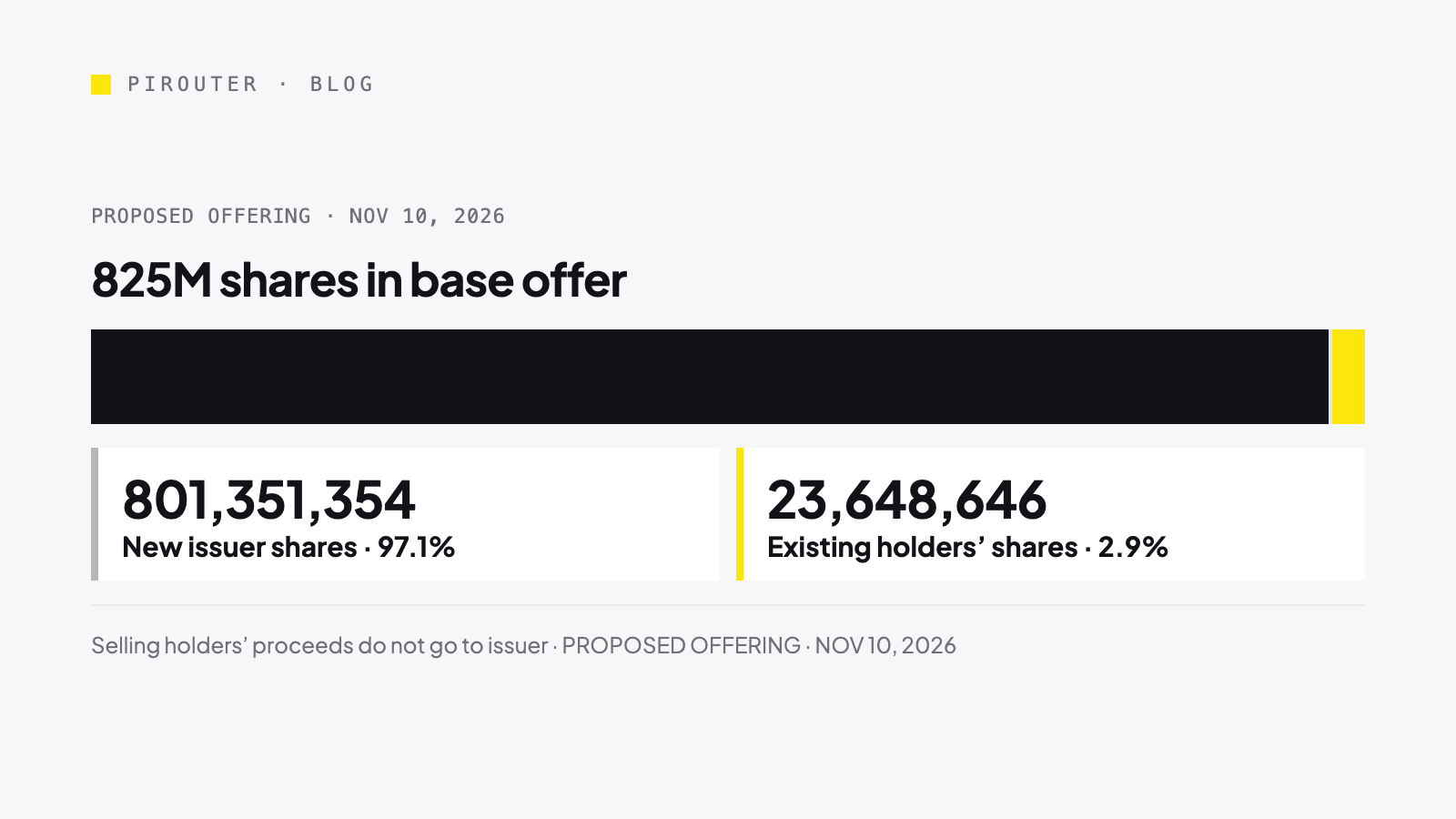
The issuer’s November 10 announcement describes 825 million Class A shares at an indicated $70–$78 price. 801,351,354 would be sold by the company and 23,648,646 by existing holders. Multiplying the base sale by the top price gives $64.35 billion of gross offering value; the company-issued portion would represent about $62.51 billion before fees, while selling holders’ shares would represent about $1.84 billion. Anthropic says it receives none of the selling holders’ proceeds. These are upper-price calculations, not proceeds already received or a company net-proceeds figure.
The issuer also grants underwriters an option for up to 123.75 million additional shares, separate from the base sale. TechCrunch reports a proposed $26 billion private placement of non-voting shares as another transaction; that number is not in the short issuer announcement and cannot be folded into the base public-offer total. The practical distinction is where any completed transaction sends resources: newly issued company shares may finance its business, whereas sales by existing holders provide those holders with liquidity.
Source scope matters once, here: the November 10 SEC S-1/A filing index is an accessible primary-document entry, but the financial footnotes in its prospectus body were not independently audited for this article. Operating and valuation figures below are attributed to their reporting sources.
Realized revenue shows the rise; the run rate shows its latest speed
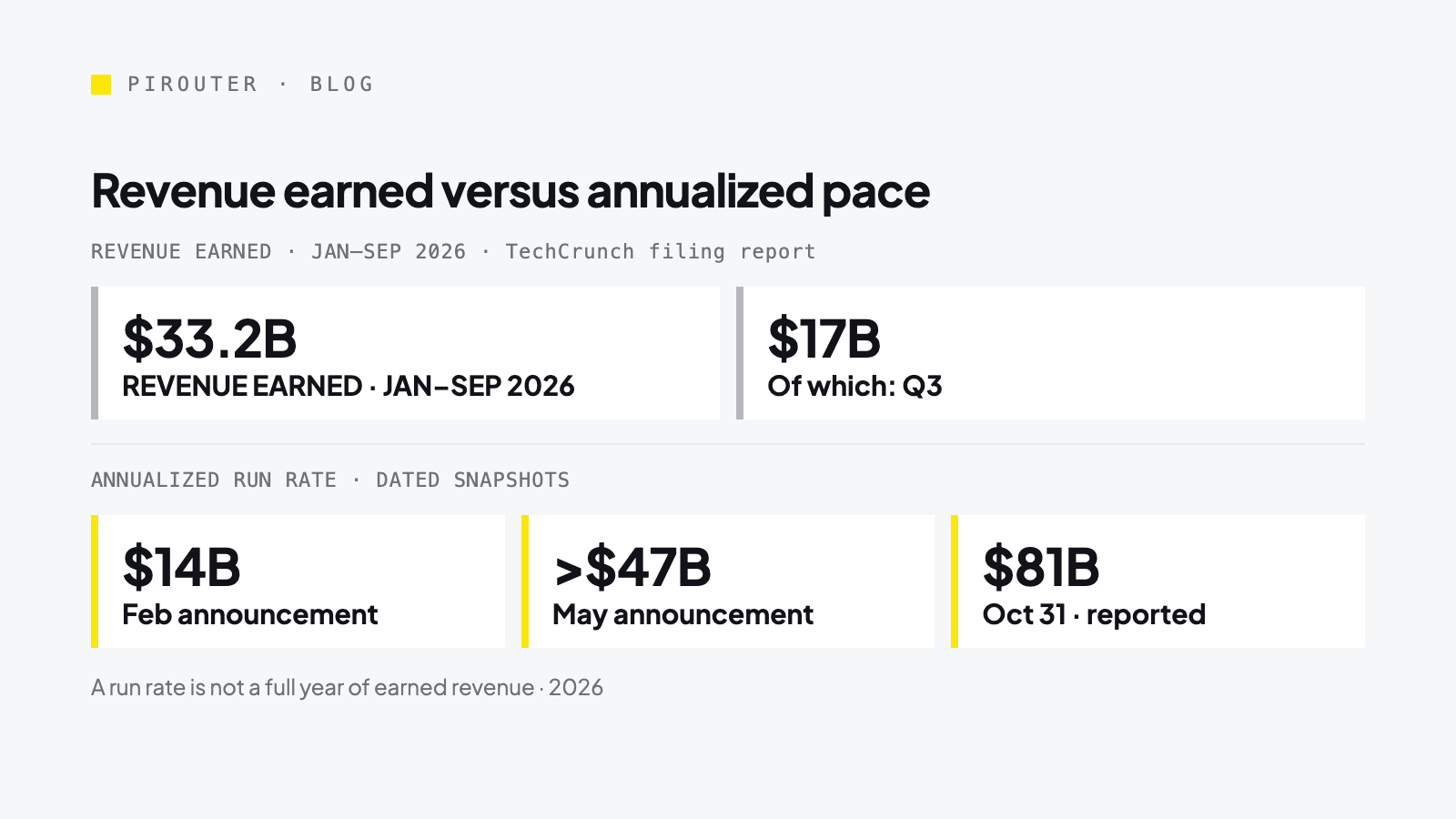
TechCrunch’s account of the amended filing puts revenue for January through September at $33.2 billion and third-quarter revenue at $17 billion. On those figures, the third quarter alone contributed just over half the nine-month total. That is a substantial acceleration in a realized reporting period. The first six months together account for the remaining $16.2 billion by subtraction, though this calculation does not reveal the separate first- and second-quarter numbers or profitability.
The company’s own dated statements provide a different, complementary series of snapshots. In February’s Series G announcement, Anthropic described a companywide $14 billion annualized revenue run rate, including more than $2.5 billion for Claude Code. In May’s Series H announcement, the company said its annualized rate had passed $47 billion earlier that month. Reuters reported an $81 billion annualized rate as of October 31. Each annualizes a pace observed at a particular point; none is a statement that the company earned that amount during the prior twelve months or will earn it in the next twelve.
Taken together, the period revenue and the dated rates make the acceleration tangible without asking one measure to do another’s job. The earlier nine-month number is the distance traveled; the October rate is the latest speed. The unresolved question is how much of that speed comes from enduring workloads and how much it costs to serve them. Multiplying the third quarter by four would produce a different annualized number because it uses an earlier three-month interval; it would not be a forecast either.
The February announcement offered one indication about the demand behind the speed. Anthropic said Claude Code enterprise subscriptions had grown fourfold since the beginning of 2026 and enterprise customers supplied more than half of that product’s revenue. That is a product-specific revenue mix and a growth factor; it does not give the absolute subscriber count or a companywide enterprise percentage. The distinction matters because enterprise spending can support repeat use, but the disclosed figures do not by themselves tell us renewal rates or margins.
The customer route is more than a model API
In its May financing announcement, Anthropic described Claude Code and Cowork in enterprise operations and named AWS, Google Cloud and Microsoft Azure as distribution channels. A direct product subscription and access distributed by a cloud intermediary can reach the same organization through different contracts. The public announcement establishes the channels, not their individual revenue share or unit economics.
Anthropic has also described a way to bring the product into organizations that need implementation help. The Claude Partner Network, announced in March with an initial $100 million commitment for 2026, offers partner training, technical assistance, sales support and joint marketing. A May announcement about a proposed enterprise AI services company described plans to help mid-sized organizations identify uses, build custom systems and obtain continuing support. The services company was announced as a plan, not as a demonstrated operating channel or realized revenue.
The commercial logic is clear enough to examine without guessing the outcome: direct products and cloud distribution can expand access; partners and planned implementation services can lower the effort of turning a model into a production workflow. Each adds costs or commercial intermediaries as well as potential demand. The question for the eventual public business is which routes lead to repeat spending that outlasts the costs of acquiring and serving customers.
Capital has been arriving before the proposed public offer. The company announced a $30 billion Series G at a $380 billion post-money valuation in February, then a $65 billion Series H at a $965 billion post-money valuation in May. Anthropic said the latter included $15 billion of previously committed hyperscaler investment. These private round terms are financing milestones, not a time series of public share prices. They show the capital scale that accompanied the rising annualized rates while leaving the quality of future earnings to be demonstrated.
One proposed price, two share-count bases—and a governance question
Reuters’ IPO report describes roughly $1 trillion of implied equity value on basic shares and about $1.4 trillion fully diluted at the proposed $78 upper price. TechCrunch gives the latter as $1.404 trillion. Both apply a proposed price to a share-count basis for the whole company. The fully diluted estimate includes potential claims such as options and restricted stock; it is not an extra $400 billion of offering proceeds or a claim that all those shares are immediately tradable.
For scale, divide those two reported estimates by Reuters’ $81 billion annualized pace: approximately 12.3 and 17.3 times, respectively. This is our illustrative arithmetic using a point-in-time annualized rate, not a historical fiscal-year price-to-sales multiple or an assessment of fair value. The useful question is whether revenue growth can persist and generate enough cash after its associated costs. A revised offer price or share count would also change the comparison.
Ownership has another dimension. Anthropic’s description of its Long-Term Benefit Trust says it is a Delaware public benefit corporation and that a special Class T of stock, held by the Trust, gives it rights to elect and remove directors. The stated purpose is to give long-term interests a role alongside outside capital. An April 14, 2026 board announcement said that, following an appointment, Trust-appointed directors then constituted a board majority. That is a dated status, not proof of the exact board composition in November or after a possible IPO.
For a prospective shareholder, voting and board rights are part of what the quoted equity value buys. The 2023 Trust explanation describes a governance design, but the terms that would govern this particular offer belong in the prospectus. Governance does not replace the operating case: no director-election mechanism can establish how much cash a growing model business will produce.
Compute obligations will be paid on a different clock
A November 11 Yicai report discusses compute commitments on the order of $900 billion, with conditional or terminable elements and payments spread across future years. It is an account of contractual exposure, not a tally of this year’s cash payments. The precise dates, purchase minimums and cancellation provisions would matter more to a financing decision than a single aggregate headline.
Model businesses incur different kinds of cost at different times: capacity can be reserved before it is used; serving an existing workload consumes resources now; developing a future model may require another investment cycle. A rise in product demand makes capacity valuable but does not tell us whether each additional unit of customer work leaves an attractive margin. The economic bridge is revenue per useful workload against the full cost of supplying it—not the subtraction of a multiyear commitment headline from a proposed IPO’s gross proceeds.
Useful evidence will include gross-margin trends under a clear definition, operating and investing cash flows, the timing of capacity payments, and renewal of enterprise spending. The public numbers cited here show accelerating sales and a significant scale of planned financing and compute. They do not supply a verified, complete cash-generation model. That is why an annualized rate can be both an achievement and the beginning of a harder test.
The roadshow announcement says the registration statement is not yet effective and identifies ANT only as the intended Nasdaq ticker. Final pricing, the distribution of proceeds and eventual trading remain future events. The issuer announcement and SEC amendment index are public starting points; no verified official slide-download link is offered here.
Claude’s reported growth has already changed the scale of the conversation. The open question is whether direct products, cloud channels and enterprise adoption will keep producing value after the capacity behind them has been paid for. That is a more demanding claim than any one annualized revenue figure—and the claim a prospective public company will have to substantiate over time.