
Anthropic's IPO roadshow meets four different AI business models
OpenAI, Google, Microsoft and Meta are funding compute and reaching enterprise customers through different mechanisms. Only Reuters sources link one funding timetable to Anthropic's expected IPO; the other developments are contemporaneous.

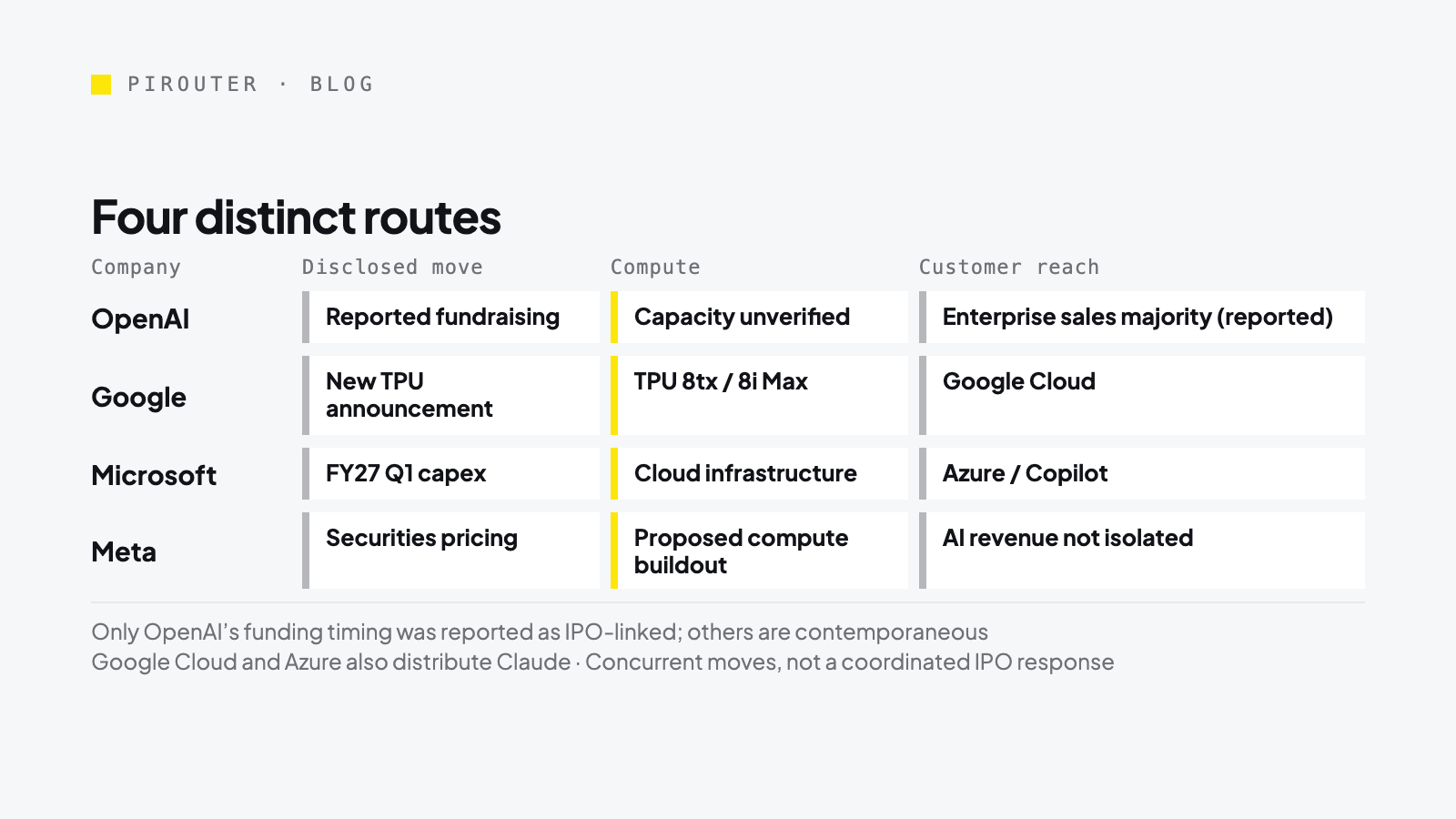
Anthropic has launched the roadshow for a proposed IPO, bringing the cost of building a frontier-model business into sharper public view. OpenAI is seeking private capital; Google is developing specialized chips; Microsoft reports cloud sales alongside major infrastructure spending; and Meta has priced two equity-related offerings. Only Reuters, citing unnamed sources, connects OpenAI’s fundraising timetable to Anthropic’s anticipated offering. The other developments are real, but their timing alone does not make them reactions to the roadshow.
The four companies cannot be sorted into a simple winner’s list by how much money they say they are raising or spending. Their operating positions differ: a private model provider needs fresh investors, two cloud businesses can distribute AI through existing enterprise relationships, and an established public company can use securities with delayed settlement to help fund its buildout. The more revealing comparison has three parts: where capital comes from, how computing capacity is supplied, and who already has a path to paying customers.
There is a wrinkle in the word competitor. Anthropic’s May Series H announcement named AWS, Google Cloud and Microsoft Azure as routes through which customers can get Claude. Google and Microsoft compete to sell their own AI products while their cloud platforms can also distribute Anthropic’s. That overlap is not evidence of identical economics, but it makes a four-way “response to the IPO” story much less useful than a look at how these businesses actually work.
Capital: private fundraising, internal capacity and a priced forward sale
The closest thing to an IPO-related move in the source record came before the roadshow. On October 19, Reuters reported that OpenAI wanted to speed up investor outreach ahead of Anthropic’s then-expected IPO. Two people familiar with the matter attributed the timing in part to competition for a common pool of capital. One described a potential raise of around $30 billion at a possible valuation above $1.4 trillion. That was an account from unnamed sources about a discussed plan, not a public OpenAI financing announcement.
The numbers subsequently changed. On November 6, TechCrunch, citing Bloomberg’s sources, reported an additional $11 billion secured in an open round at a reported $1.25 trillion valuation, with a possible $20 billion eventual total. The report did not specify whether its valuation was pre-money or post-money. The October amount discussed, the November report of funds secured and a possible final total describe a financing process at different times. None is an invitation to add them together or compare the reported private valuation penny-for-penny with a public offering’s diluted-share calculation.
Microsoft and Google supplied a different kind of capital evidence: quarterly disclosures from businesses that already have large Cloud channels. On its FY27 first-quarter earnings call, Microsoft reported $45.2 billion in quarterly capex and projected more than $50 billion in the next quarter. The quarter was fiscal 2027 Q1, not a full calendar-year 2026 period. About three-quarters of its first-quarter capex was short-lived assets, primarily CPUs and GPUs, according to management. The figure covers the company, not just AI. Alphabet’s October 28 earnings remarks emphasized TPU demand and rapidly expanding Cloud revenue without presenting a directly comparable stand-alone TPU expenditure number. The absence of that number is not evidence of a smaller chip program.
Meta paired a spending plan with a distinct funding mechanism. Its third-quarter release reported $34.91 billion in Q3 capex, including finance-lease principal payments, and gave $135 billion–$145 billion as full-year 2026 capex guidance on the same basis. The latter is a forecast, not a completed year’s expense. A comparison with Microsoft’s $45.2 billion single-quarter figure would have to account for both time period and reporting basis; neither number is a clean “AI-only spending” total.
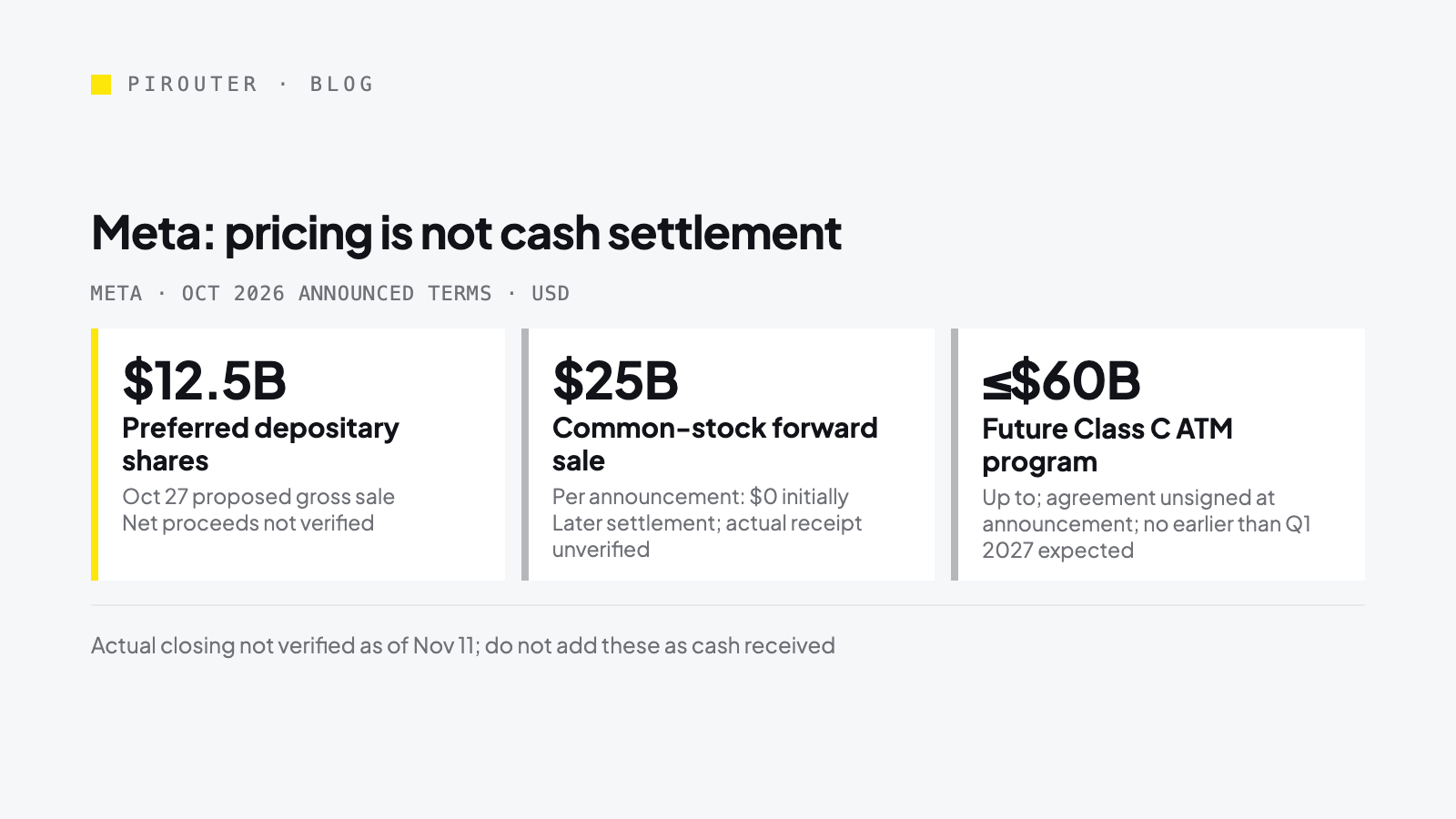
On October 26 Meta launched proposed offerings initially sized at $22.5 billion in Class A forward sales and $12.5 billion in depositary shares representing mandatory convertible preferred stock. Its next pricing announcement specified 40 million Class A shares at $625, raising the forward-sale headline to $25 billion, and 250 million preferred depositary shares at $50, or $12.5 billion in priced value. The forward arrangement initially sends no Class A sale proceeds to Meta; the announcement estimated around $24.9 billion before expenses on a future settlement. The pricing page expected a conditional close around October 29, but as of this research cut we have not verified actual completion from that expectation.
Meta also described a possible future Class C at-the-market program up to $60 billion that had not been agreed and was not expected to start before Q1 2027. Reuters’ $97.5 billion aggregate headline joins the priced $25 billion and $12.5 billion with that possible later $60 billion capacity. It is a picture of potential transaction scale, not $97.5 billion of cash received. More important than its size is the mechanism: Meta can price an equity-related forward transaction now while its cash timing and a separate future issuance remain different questions. It is already a listed company, not conducting another IPO.
Compute: control the chip, rent the cloud or finance the buildout
Google’s November 9 TPU announcement addresses two specific infrastructure constraints. TPU 8tx, based on the same silicon as 8t and paired with AMD EPYC hosts, is positioned for confidential workloads; Google says it can cut latency by up to a factor of two against the specified 8t comparison. TPU 8i Max combines two 8i chips in a package, with Google claiming twice the compute, SRAM and HBM bandwidth of a single 8i. These are Google’s comparisons within its own chip lines, not independent cross-company benchmarks. The announcement gives no verified broad customer-availability date for either design.
What matters commercially is the option to shape the hardware and its cloud service together. A provider with that control can choose chips for particular requirements rather than treating all workloads as identical. The announcement does not show that a specific workload is cheaper to run or that customers have already bought the new chips. TechCrunch’s independent chip report describes a broader hardware portfolio, not an IPO countermove.
Microsoft’s October capex disclosure illustrates a different view of supply. A large share of the quarter’s reported spend went to shorter-lived equipment, including CPUs and GPUs, inside a business that sells Azure and productivity software at scale. The economics hinge not only on purchasing capacity but on putting it to work for paid services over time. Quarterly capex cannot be subtracted from quarterly Cloud revenue to yield “AI profit”: the spending and revenue measures have different scopes and accounting treatment. The information is useful precisely because both the capacity bill and the distribution business are visible, even without a standalone AI margin.
Meta’s reported capex and its forward-sale mechanics put yet another clock on supply. Financing capacity can be priced before a forward share sale produces company proceeds; hardware spending takes place on its own schedule. That does not mean the forward transaction has already funded the $135 billion–$145 billion full-year guidance, or that guidance is a one-time AI bill. Nor does it prove exactly which models or workloads will use the assets. It shows a listed company publicly staging large expected infrastructure investment and a possible route for later cash receipts.
OpenAI’s compute path in this source set is less directly documented. The cited Reuters accounts concern financing timing and enterprise revenue mix, not a newly announced chip, a measured unit cost or a verified capacity delivery schedule. Funding could buy access to computing resources, but the available reports here do not quantify which resources or when they will serve revenue-generating work. That asymmetry is itself useful: choosing four companies does not entitle us to invent four matching chip specifications.
These figures cannot form a capex ranking: Google gives no comparable chip-spend total; Microsoft’s company-wide quarter and Meta’s lease-inclusive quarter have different scopes; OpenAI’s cited reports discuss fundraising. The question is when paid capacity becomes useful.
Distribution: who can turn capacity into repeat enterprise spending?
A chip is valuable only when customers can use the service it enables. Alphabet’s Q3 CEO remarks said Google Cloud revenue rose 103% year over year, described broad TPU demand and cited enterprise Gemini deployments. That is evidence of a growing existing Cloud channel, not a revenue line for the November TPU 8tx or 8i Max. The later chip announcement cannot have caused the earlier quarterly figure. Its commercial test will be whether available hardware improves what that channel can deliver for a known workload and price.
Microsoft supplied both a monetary measure and narrower adoption measures. The FY27 Q1 call reported $63.9 billion in Microsoft Cloud revenue, up 30%, and 48% Azure revenue growth. Its earnings release put total company revenue at $92.3 billion in the same fiscal quarter. Cloud is not AI-only revenue, and Azure growth is not a separate sum to add to Microsoft Cloud. They indicate the scale and momentum of the route through which enterprise AI can be sold.
Management also said Copilot daily active users had risen nearly 50% quarter on quarter and more than fivefold year on year, while the number of customers with more than 50,000 seats had increased more than eightfold year on year. Those are growth rates without an absolute active-user or customer count. They point toward existing software procurement and usage as an advantage; converting adoption into attractive incremental economics remains a separate test.
The Google and Microsoft routes overlap with Anthropic’s rather than excluding it. As Anthropic’s Series H announcement made explicit, its customers can access Claude through Google Cloud and Azure as well as AWS. An enterprise might encounter multiple models through a cloud relationship and evaluate products built by the distributor too. That creates competition and distribution at once. It does not establish which company captures a particular customer’s spending or margin, but it does make the cloud relationship a source of commercial reach for more than one model maker.
OpenAI described a more direct enterprise revenue signal. In Reuters’ report on Greg Brockman’s remarks, enterprise sales account for more than half of company revenue. That is revenue share, not an enterprise-customer majority or a disclosed margin. Brockman also said the company could be IPO-ready in 2027, according to TechCrunch’s account; it is a view about possible readiness, not a filed listing date. The customer mix makes private fundraising more than a purely speculative research-capital story, while leaving retention and the cost of serving those customers open.
Meta has disclosed the investment side and the instruments that may help pay for it in these particular sources, not a comparable standalone AI revenue series. We can describe its capital architecture without claiming a specific AI customer count or a product-return percentage that the cited Q3 release does not provide. That is a limitation on cross-company comparison, not a reason to discard the financing story. An operating business with capital-market access can stage a buildout differently from a private model provider seeking another investor round.
Three mechanisms, four distinct questions to watch
When Anthropic’s proposed IPO draws attention to the cost of frontier AI, the temptation is to compare four impressive financial figures as if they measured the same race. A discussed OpenAI funding target, Google’s reported Cloud growth, Microsoft’s quarterly company-wide capex and Meta’s priced forward-sale value do not occupy the same accounting line. They have different time windows and different relationships to cash. The one reported causal connection—the Reuters sources on OpenAI’s financing timetable—should stay narrow.
Each route suggests a concrete next observation. OpenAI: disclosed final funding terms and recurring enterprise sales, not an anonymous target alone. Google: actual availability and measured customer economics for its new TPUs, alongside Cloud demand. Microsoft: the relationship between realized infrastructure spending, Azure sales and AI-specific revenue as reporting permits. Meta: evidence of completed transactions and forward settlement, plus actual spending against its full-year guidance. These are separate operating tests, not a prediction of which company’s stock or product will win.
Capital pays for a chance to build capacity. Capacity becomes a business only when customers repeatedly find enough value to pay for it. The four companies are approaching that bridge from different sides, and some can even distribute a rival’s model on the way across. Anthropic’s roadshow does not make their choices a coordinated response; it makes the differences newly worth reading.