
TorchTPU makes PyTorch portable. Your performance assumptions still need work.
TorchTPU brings native eager execution and torch.compile to TPUs. Before moving a CUDA workload, check XLA compilation, dynamic shapes, precision defaults and process layout—not just the device string.
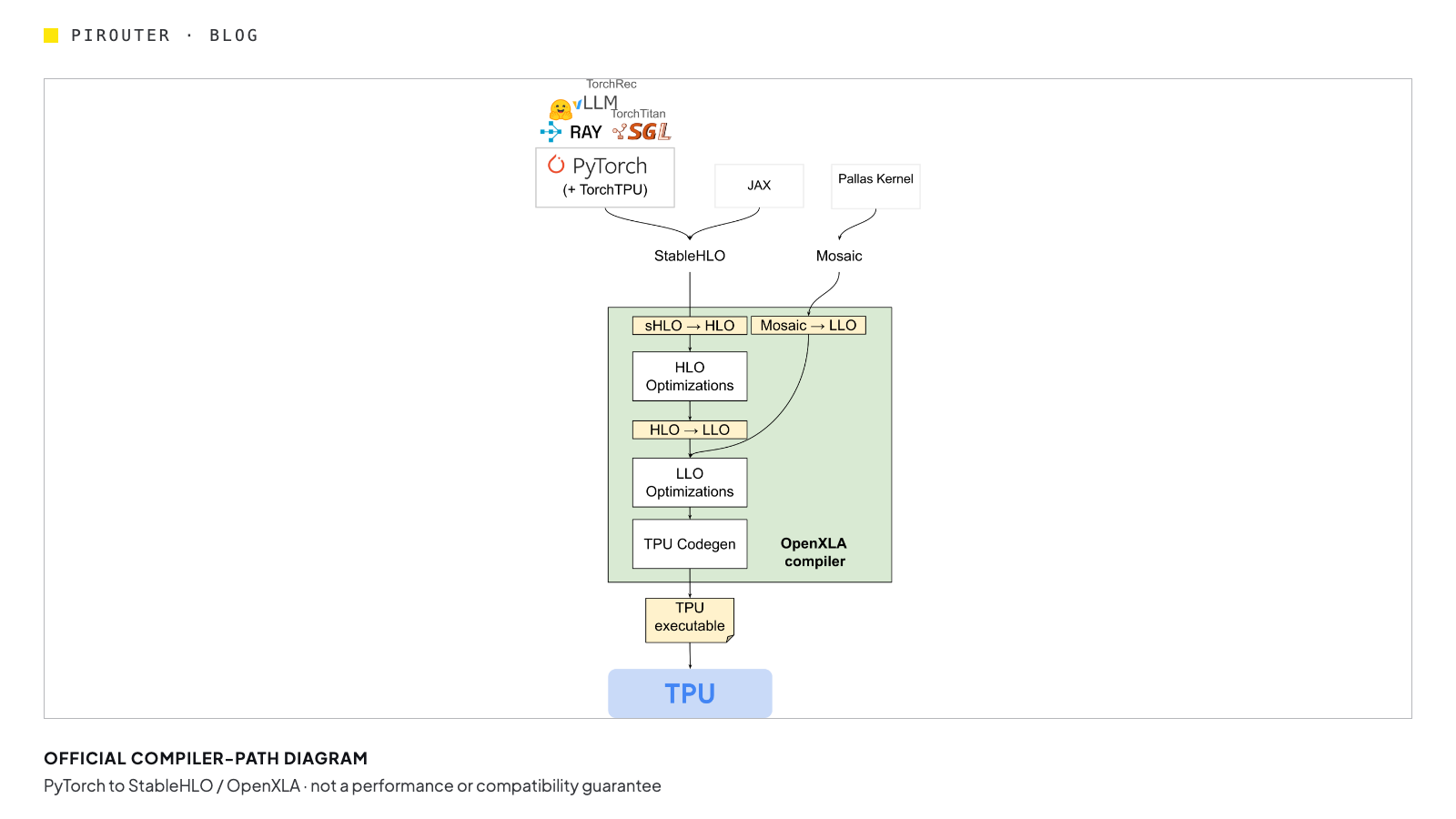
TorchTPU gives PyTorch a native TPU backend, including eager execution and torch.compile; the entry point can be as small as changing a device target. It does not make a CUDA workload’s peak performance, precision behavior or process layout portable by default. This is a reading of the official implementation and support boundaries, not a new GPU-versus-TPU benchmark.
That distinction matters before a team commits to moving training or inference. Getting the model to execute is an important result. It is not yet evidence that the same batch sizes, changing sequence lengths and distributed arrangement will produce the same answers at a better total cost.
Native PyTorch does not remove XLA
The Introducing TorchTPU technical article describes a backend built around PyTorch’s own dispatch and compilation interfaces. Eager is PyTorch’s ordinary operation-by-operation programming interface; compiled mode captures work for optimization. Eager execution remains a first-class option, while compiled execution uses TorchDynamo rather than asking the application to adopt a separate lazy-tensor programming model. The TorchTPU repository supplies the public implementation and setup entry points.
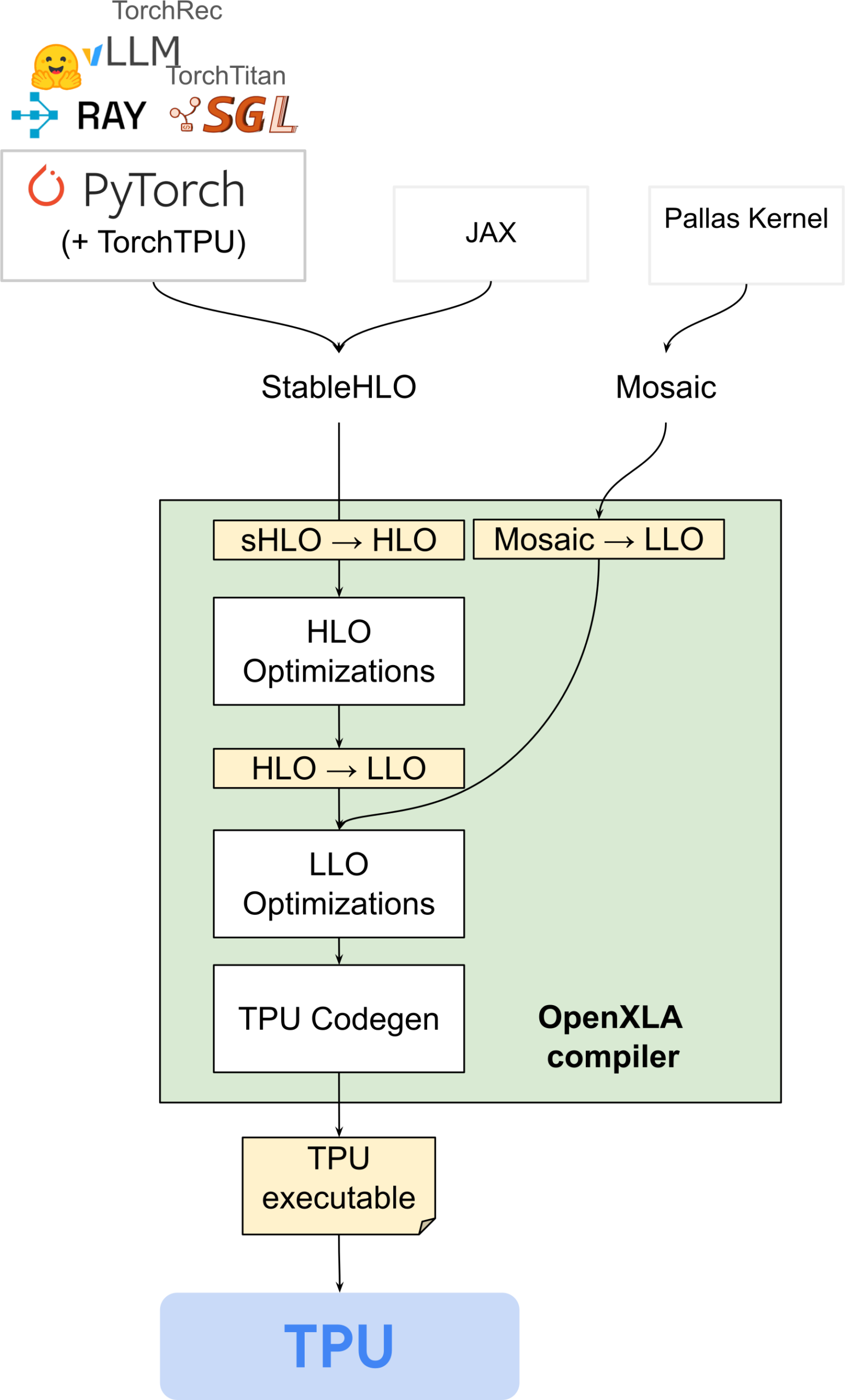
The lower layers are still TPU-specific. Operations pass through the XLA compiler stack, with StableHLO representing computations and PjRT providing compilation, execution and device transfers. “Native” describes the relationship to PyTorch. It does not mean that XLA has disappeared or that GPU execution machinery has moved unchanged onto another chip.
The article’s promise of no JAX dependencies is also about the runtime. It separately describes optional custom-kernel authoring through JAX/Pallas. A runtime that does not depend on JAX and a developer choosing that kernel-authoring route are different claims; neither should be used to erase the other.
Imagine an existing model whose application code selects cuda, transfers tensors and calls standard PyTorch operations. Changing the target to tpu may substantially reduce the porting work. The official article nevertheless says that shapes, sharding and operations chosen around a GPU can need further changes to reach peak TPU performance. That qualification belongs next to the device-change example, not in the footnotes of a migration plan.
The first useful question is therefore whether the relevant computation runs correctly through this backend. Only after that does it make sense to ask whether its execution pattern suits the hardware.
Shapes and compilation change the cost of a request
Familiar eager syntax does not imply that every operation has an identical execution cost on the two backends. TorchTPU describes strict eager execution, a blocking debug mode and a hybrid DeferAndFuse mode that groups deferred operations before materialization. The application can look imperative while the backend makes decisions about compilation and when results must become available.
The clearest deployment caveat is in compiled mode. The technical article says TorchTPU temporarily sets dynamic=False when invoking torch.compile, because support for symbolic integers requires bounded dynamism that is not enabled by default. The current feature matrix also separates experimental dynamic features from validated coverage.
For a hypothetical serving workload with changing sequence lengths, this is not a detail to postpone until the end. Different shapes can change compilation behavior. A demonstration using one fixed input length does not establish the behavior of a queue containing short, long and irregular requests. The backend is working on bounded dynamism; a roadmap direction is not a reason to assume that the current limitation has already gone away.
Compilation caching then changes how a measurement should be interpreted. The official design has a process-local cache, a machine-local shared cache and a persistent remote-filesystem cache. The first is always enabled. The second defaults differently for distributed and single-device programs; the third is disabled unless a shared storage path is configured.
Consequently, a warm loop in a long-lived process and the first request after a job restart are not interchangeable observations. A remote cache can be part of a deployment design, but it is not an always-on property to assume from the model code alone. The article’s cache keys also include shapes, compiler options and component versions, which makes the exact environment relevant when interpreting reuse.
None of this gives a measured cold-start penalty for your model. It tells you what a useful measurement must distinguish: first execution, repeated execution, input-shape variation and restart behavior. Collapsing them into one tokens-per-second number loses the part that often determines whether a service is pleasant to operate.
The same precision setting can buy different arithmetic
A successful port should also preserve the result you actually need, not merely return a tensor of the expected shape. TorchTPU’s numerical-precision section makes this unusually concrete.
The article describes TPU matrix multiplication using BF16 inputs with FP32 accumulation in its default medium mode. Higher precision uses multi-pass algorithms: the documented high path uses three passes, and highest uses six. Those are descriptions of the matrix-compute mechanism and its associated work, not proof that an entire training job becomes exactly three or six times slower.
This differs from treating a precision label as a hardware-independent promise. The same application setting can select a different implementation on another accelerator. Non-contracting operations have their own execution path, too; reducing the whole framework to “everything runs in BF16” would be inaccurate.
For a team moving an existing workload, numerical checks should sit beside the performance checks. If a fixed evaluation input changes beyond the tolerance the application permits, a faster run has not passed the migration gate. Conversely, selecting the most expensive precision setting everywhere without identifying a numerical need can hide the benefit of the new backend.
A practical evaluation would record the chosen precision mode and compare outputs or convergence against an explicit reference. That is a proposed validation step, not a result from this article. We have not run a TPU experiment and cannot tell you which mode is sufficient for a particular model.
The important point is narrower: “same PyTorch code” does not excuse leaving arithmetic assumptions out of the comparison. A throughput chart without its precision configuration is missing information needed to make the number useful.
Distributed layouts need a separate migration check
TorchTPU’s integration with familiar distributed interfaces reduces another kind of rewriting, but the hardware still imposes its own execution model. The technical article describes one process per TPU device and notes that a TPU can be accessed by only one user-space process. It explicitly says reinforcement-learning colocation is not supported out of the box under that constraint.
That is enough to reject a universal “change the device and keep the entire distributed job” recommendation. It is not enough to reject TorchTPU for all reinforcement-learning work, or to claim that no alternative arrangement could work. The supported process layout and the application’s intended sharing pattern need to be compared rather than inferred from a model’s successful forward pass.
Hardware coverage has the same requirement. The current feature documentation lists v5e, v5p, v6e and v7 as validated; v8i and v8t remain on its roadmap. A technical article discussing newer TPU architecture does not itself prove that the backend has validated support for every chip it mentions.
The support labels also matter within a generation. The feature matrix separates validated paths, experimental work and future priorities. Some serving and fine-tuning arrangements are characterized as production uses, while other distributed or dynamic features carry experimental qualifications. The main article says some large customers already use TorchTPU in production. Neither statement means that every combination of model, operator and deployment pattern has the same status.
Finally, this remains a TPU route. The TorchTPU VM getting-started guide assumes an existing cloud TPU VM and demonstrates a Python environment with device placement. Installing a package is not evidence of TPU execution on a CPU-only laptop, nor does the guide establish the total cloud bill. A small-model local-runtime decision and a cloud-accelerator migration are different purchases.
Choose an adoption gate, not a benchmark headline
The useful evaluation is not an attempt to reproduce every number in the launch material. It is a sequence of decisions about the workload you would actually move.
Start with correctness for the operations, shapes and precision settings that matter to the application. Then separate steady-state execution from compilation, restarts and shape changes. For distributed work, validate the intended process and sharding arrangement rather than assuming that a supported model name certifies the complete job.
Cost comes after those conditions are explicit. Hardware time is only one input; a meaningful comparison also needs the workload’s completed work, the configuration used to obtain it and the operating environment. Include compilation and restarts, plus remote cache storage where used, in that trial’s cost accounting. A public package or a vendor’s production deployment does not supply that measurement for a different team.
Keep a version record with the result. The repository, package and documentation are distinct artifacts, and a documentation URL containing 0.2.0 is not an immutable guarantee that every paragraph describes the original package release. If a configuration matters to the decision, record the code and dependency versions rather than treating the current page as a timeless compatibility contract.
TorchTPU makes an important first step cheaper: expressing a PyTorch workload for TPU without adopting an unrelated application programming model. The next step is deliberately less glamorous. Verify the assumptions that were previously supplied by CUDA, and keep only the ones the new execution path actually earns.