
Strands Decider v2: When Single-Pass Routing Beats Calling an LLM
AWS Strands Labs released five Apache-2.0 Gemma 4 decision models that score options in one forward pass. Here is where calibrated routing pays off and where GPU overhead does not.
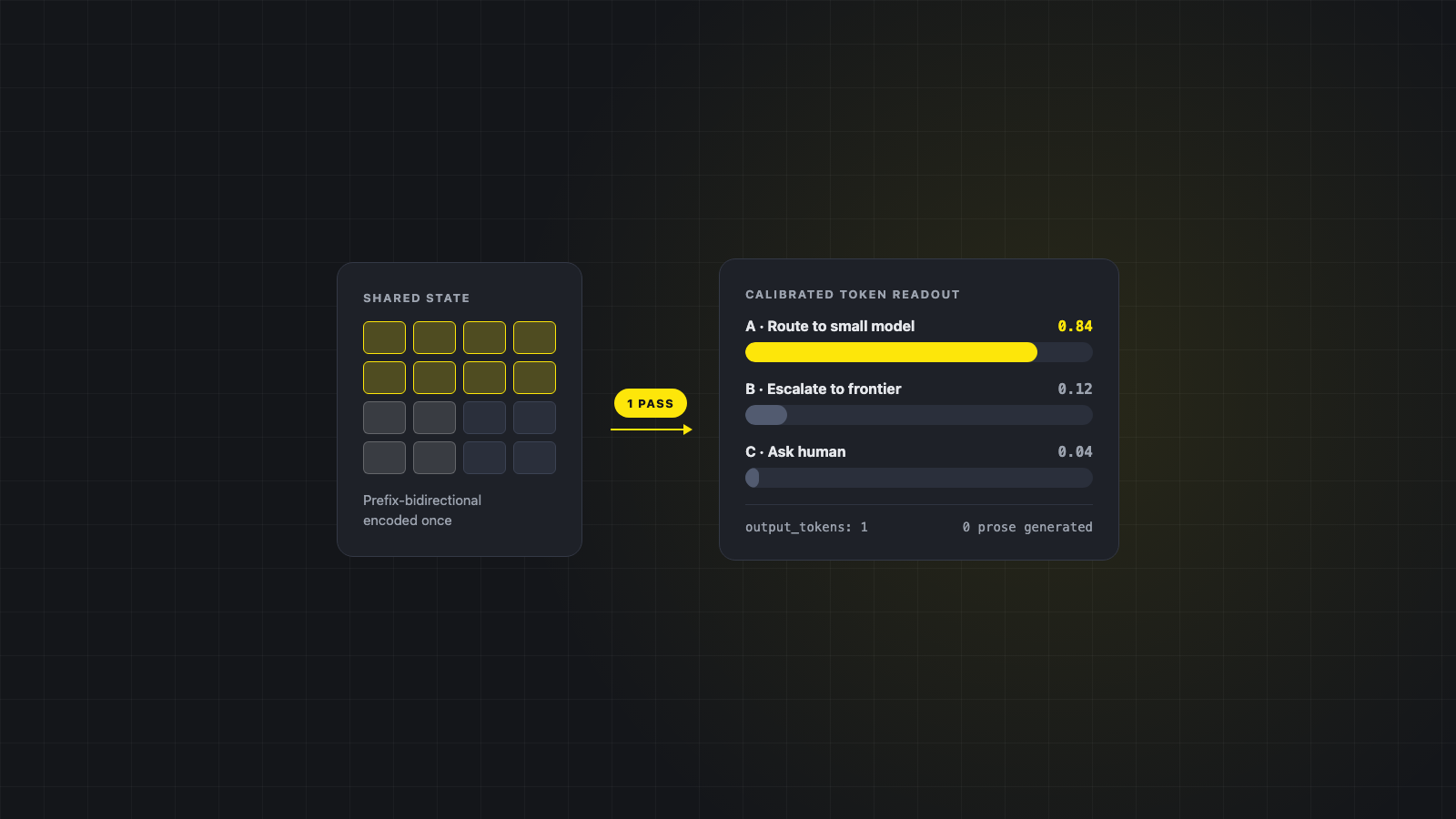
Most routing and guardrail steps inside an agent loop do not need a paragraph of prose. They need a pick from a short list, a yes/no gate, or a score on a fixed rubric. Calling a frontier generative model for that decision means paying for autoregressive decoding, waiting on token-by-token latency, and parsing text that still cannot tell you whether the model was guessing.
On November 23, AWS Strands Labs released Strands Decider v2: five open-weight “system one” decision models built on Gemma 4 instruction-tuned bases, from E2B to 31B, under Apache-2.0. The weights are published under the StrandsAgents Hugging Face organization, and the CLI, server, and training recipes live in the Strands Decider GitHub repository. Instead of generating text, a Decider model reads a shared state, question, and option list in one forward pass and returns a calibrated probability for each option.
Why dropping the LM head changes agent-loop latency
The architectural change from v1 to v2 is what makes multi-check agent steps cheap. Version 1 attached a separate pointer head and ran causal attention. Version 2 replaces the standard language-model head with a 255-row token readout initialized from the rows for option tokens A through IV, drops the rest of the vocabulary head, and switches to prefix-bidirectional attention.
Because the model never generates tokens, the entire call is prefill. The shared state—such as a support ticket, a tool trace, or an image—is encoded once with bidirectional attention, and every question in the request attends only to that shared state and to its own prompt tokens. Asking three questions about one agent trace (choice, noul for yes/no, and score for an ordered scale) does not re-encode the state three times.
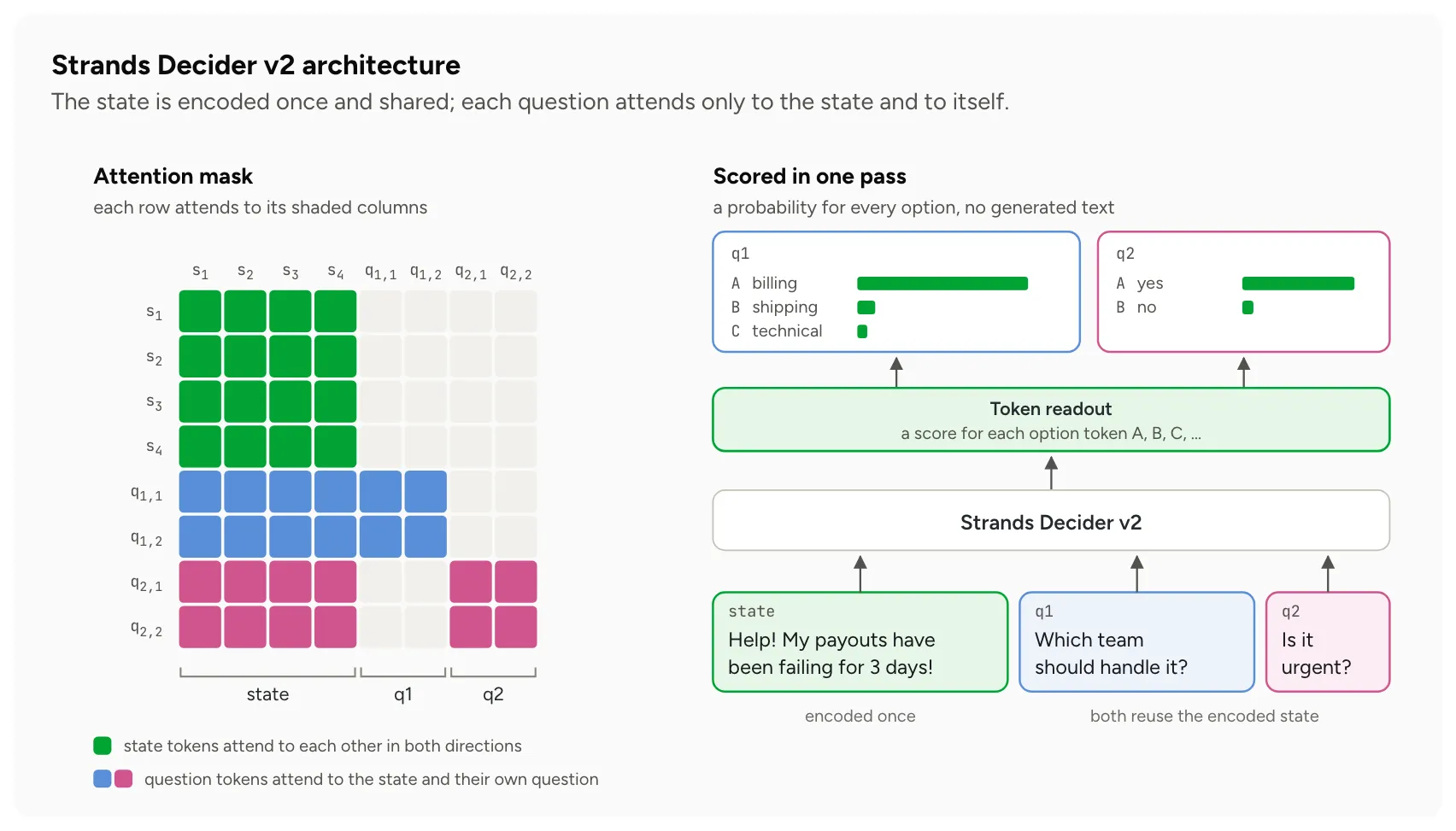
That design also defines the hard boundary. Options are passed at request time, so you do not retrain to add a label, but the schema caps a question at 255 options and outputs zero free-form explanation. If a workflow needs a written rationale or open-ended synthesis, a decision model is a gate in front of a generative model, not a replacement for it.
Five sizes, 62 to 99 ms, and the hardware bill
Strands Labs trained each v2 checkpoint for one epoch on 17.48 million decision examples using rank-64 LoRA (adapting every routed expert in the 26B-A4B MoE variant), averaged three seeds into a model soup, and fitted a held-out calibration temperature. All five v2 checkpoints support a 32,768-token context and image inputs.
The repository publishes the following benchmark and H100 latency numbers for the five v2 checkpoints:
| Model | Decision Index 0.3 | JevBench | GPU to use | H100 median latency / JevBench question |
|---|---|---|---|---|
strands-decider-E2B-gemma4-v2-2611 | 57.1 | 87.4 | 24 GB (or CPU) | 62 ms |
strands-decider-E4B-gemma4-v2-2611 | 63.2 | 88.3 | 40 GB | 78 ms |
strands-decider-12B-gemma4-v2-2611 | 64.1 | 92.2 | 48 GB | 80 ms |
strands-decider-26B-A4B-gemma4-v2-2611 | 69.0 | 92.6 | 80 GB | 86 ms |
strands-decider-31B-gemma4-v2-2611 | 71.5 | 93.1 | 80 GB | 99 ms |
Two cautions belong right next to that table. First, the Strands Decider repository notes that JevBench contains only 231 tasks, so single-run gaps smaller than roughly ten tasks are not enough to declare a winner on their own. Second, open weights shift your cost curve from variable per-token billing to fixed hosting capacity. Running 12B on a 48 GB GPU or 26B-A4B / 31B on an 80 GB GPU makes sense when you screen tens of thousands of routing or guardrail decisions a day; Amazon’s internal ticketing team reported a 98% cost drop and 78% faster calls after replacing Claude Sonnet 4.6 with v1 on SageMaker AI. For a low-volume prototype handling a few hundred calls a day, keeping a dedicated GPU warm can cost more than sending those routing prompts to a small hosted API model, unless you can tolerate the quantized arm64 CPU Lambda path or share an existing GPU with E2B or E4B.
Calibration is what makes escalation rules work
Accuracy alone is not enough for a router. What lets a cascade save money safely is knowing when the fast model is uncertain. On six public text benchmarks reported by Strands Labs, v2 31B raised average accuracy to 82.1 (from 70.0 for v1 26B-A4B), while cutting expected calibration error (ECE) from 0.062 (0.063 in the chart label below) to 0.027; v2 E4B reached 74.4 accuracy and 0.031 ECE.
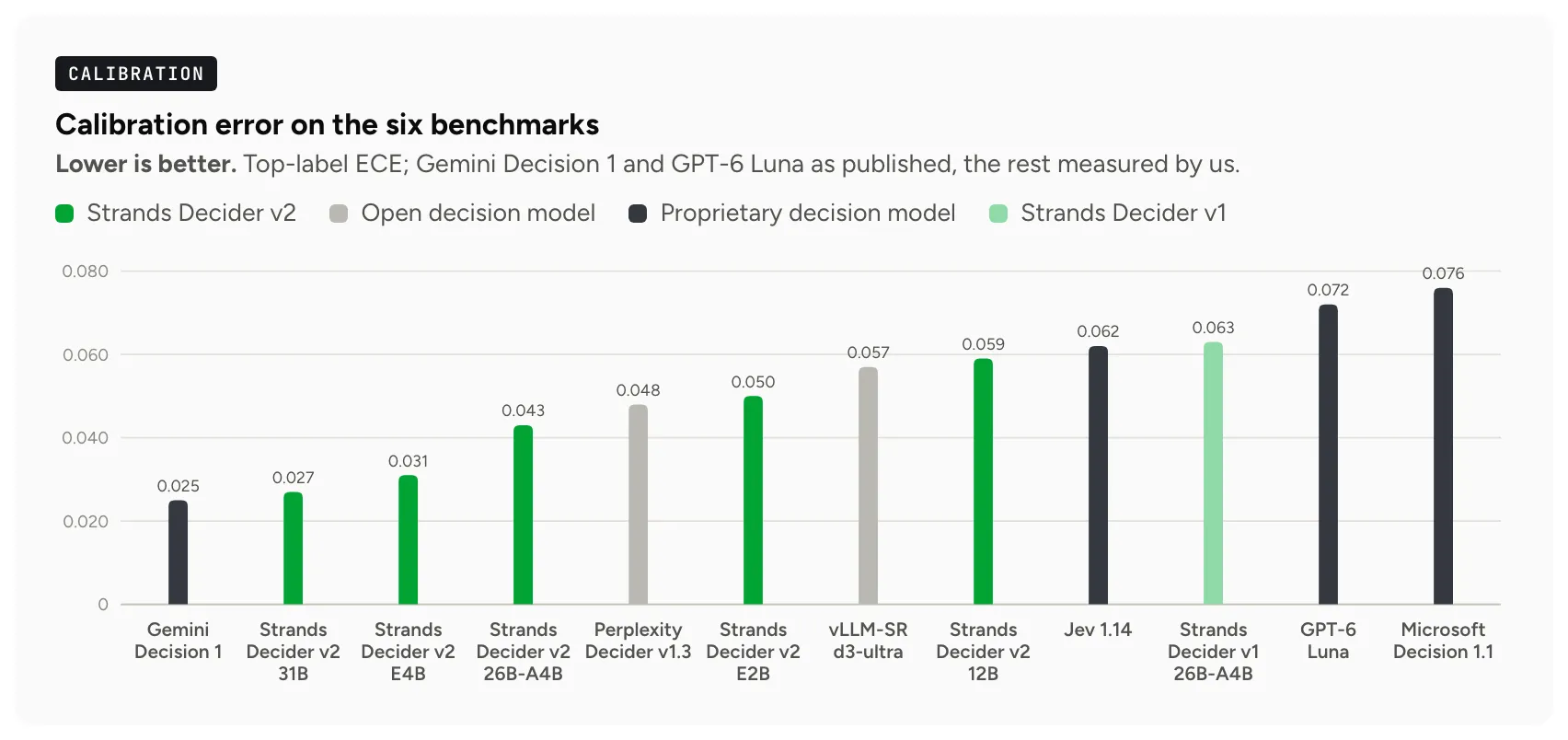
In Strands Labs’ routing experiments without task-specific fine-tuning, that calibration translated directly into cascade efficiency:
- Pre-call routing (Haiku 5.5 vs. Sonnet 5.5): Splitting a mix of customer-service and app-automation tasks solved 94% as many tasks as Sonnet alone at 44% of the cost—11.7 more tasks per 100 than a random split at the same spend.
- Cross-provider routing (LLMRouterBench): Routing between DeepSeek V3 and Gemini 2.5 Pro reached 88% of Gemini 2.5 Pro’s accuracy at 18% of its cost.
- Post-call verification (AutoMix): Sending the least-trusted half of Llama-2-13B’s reading-comprehension answers to Llama-2-70B recovered 94% to 99% of the larger model’s gain, compared with 50% for a random half.
The Strands Decider evaluation notes and README state the operational rule clearly: on unseen short classification tasks, answers at 0.9 confidence or higher are right roughly 95% of the time; below your chosen threshold, escalate to a stronger model or a human. Do not hard-code 0.9 blindly for long agent traces or domain-specific safety checks—measure your own reliability curve first.
Four checks before replacing a generative router
If you are evaluating Strands Decider v2 for model routing, tool-argument checking, or inline guardrails, run four narrow tests before committing GPU budget:
- Confirm the decision fits closed options. Map your routing or guardrail step to
noul,choice(at most 255 options), orscore. If downstream code still needs a natural-language explanation for every call, keep a generative model for that step. - Run a shadow pass on real traffic. Serve
E4Blocally viastrands-decider serve—or compare12Band26B-A4B, noting thatv2 12Bposts 0.059 ECE in the chart above versus 0.031 forE4B—and log probabilities against 500 to 1,000 labeled production traces. Check both accuracy and calibration buckets, not just top-1 accuracy, to set your escalation cutoff. - Time realistic prefill lengths, not short demos. The 62–99 ms figures are H100 medians on JevBench, not guarantees for long prompts or short one-sentence demos (like the README’s 86-token example). Measure p95 latency at your actual trace length (especially near the 32,768-token ceiling or with base64 images) on the exact GPU or CPU tier you plan to run.
- Compare monthly GPU floor against token spend. Price a real-time SageMaker endpoint, a shared GPU, or quantized CPU Lambda against your current monthly spend on small-model routing calls. Switch only where the fixed compute floor clears the token bill with headroom for peak traffic.
Strands Decider v2 is most compelling when an agent runs several routine gates on every turn—tool checks, grounding screens, and tier routing—where one shared prefill and a calibrated confidence score replace repeated generative calls. If you only route occasionally or need written reasoning on every branch, a hosted generative router remains simpler to operate.