
Jev vs GLM-5.3-Flash: similar accuracy, very different reasons to choose either
A vendor-run 28-dataset comparison found no clear accuracy winner between Jev and one-pass GLM-5.3-Flash. Compare the September 2026 price, latency, confidence and self-hosting trade-offs.

Suppose a support ticket must go to payments, complaints or technical. You need a choice and uncertainty signal, not a paragraph. TypeSafe’s Jev is built for typed decisions; open-weight GLM-5.3-Flash can imitate its interface by reading numbered-option probabilities after one model pass. In a vendor-published benchmark, neither won on 28 public text datasets. At September 2026 list prices, however, Jev cost roughly a quarter as much per decision as GLM on Privatemode’s hosted service. Open weights offer other advantages: image input, local data and vendor independence.
Privatemode wrote the benchmark and sells the GLM deployment; we tested neither system. Prices and latencies below are historical results in its test environment, not a new run or current quote. Your tickets may differ from public intent datasets.
How can GLM make a typed decision without generating an explanation?
Jev’s launch description defines a specialized model that returns probabilities over fixed choices rather than text. A conventional autoregressive LLM normally writes a token and then another; you could ask it to reason aloud, but that spends time and output tokens on an answer that still needs parsing.
Privatemode’s one-pass recipe changes what is read. It puts the input and a numbered option list into the prompt, pre-fills the assistant answer up to answer:, then requests one token. The server restricts that token to the option numbers and returns the log-probability of each permitted number at that position. Normalize those values over the choices and you have a distribution. The restriction guarantees a valid number; reading all the relevant log-probabilities is what supplies the distribution. It is not Jev’s internal architecture, and it required no tuning of GLM’s weights.
For that ticket, define 0 = payments, 1 = complaints, 2 = technical, then send uncertain choices to a human. Each number must be one token in the serving tokenizer; the library reports 0–190 for this GLM model. Ordinary top_logprobs can miss options because it returns the unmasked top tokens. Privatemode uses vLLM-specific allowed_token_ids and logprob_token_ids (implementation notes); the method cannot port unchanged to an endpoint without these extensions. Fetch IDs from your serving tokenizer. For reproducible implementation, start with the open library and place shared input first to benefit from prefix caching.
What did the Jev–GLM benchmark measure, and what did it leave out?
The public methodology used 29 labelled datasets—24 English, five German—with between two and 151 options; one dataset consisted of scanned documents that text-only Jev could not process. The 28 shared text sets gave Jev ten wins and the one-pass GLM ten, with eight within a percentage point. The paired comparison reported p = 0.64: the results do not establish that their accuracy is equal in every task, only that this benchmark did not resolve a winner. Each dataset was run twice, and the authors themselves caution about run-to-run noise.
The repository includes two useful controls: GLM with reasoning before its answer, and zero-shot embedding similarity between input and option names. This is not a production rule engine, nor an embedding router trained on your labelled examples. Here is the published suite summary, with its September 2026 pricing assumptions:
| Method | Mean accuracy normalized against majority-class guessing | Median EUR / 1,000 decisions | Latency in that setup | Images |
|---|---|---|---|---|
| Jev | 0.574 across 28 sets | 0.0156 | 251 ms median from Germany | No |
| GLM-5.3-Flash, one pass on Privatemode | 0.585 across 29 sets | 0.0624 | 152 ms median from Germany | Yes |
| GLM with reasoning first | 0.665 across 29 sets | 0.3487 | 7.2 s mean | Yes |
| Zero-shot embedding similarity | 0.355 across 28 sets | 0.0054 | Not measured | No |
Normalized accuracy is zero at the majority-class baseline for a dataset and one for perfect answers; the 28-versus-29 counts make the two summary means not a direct paired accuracy comparison. For that, use the 28 shared-set result above. The ratio of the two median decision costs is 4.0; calculating the median of 28 separate per-dataset price ratios gives roughly 3.5, by our arithmetic. Both describe Privatemode’s hosted GLM at the benchmark’s list price, not a bill for running your own model.

On toxic_conversations, where 93% of examples share one label, both lost to always choosing that label. The authors estimate 17% of banking77 labels are ambiguous. Public per-dataset results help audit the work; they do not make a vendor’s benchmark independent.
When does latency change the recommendation?
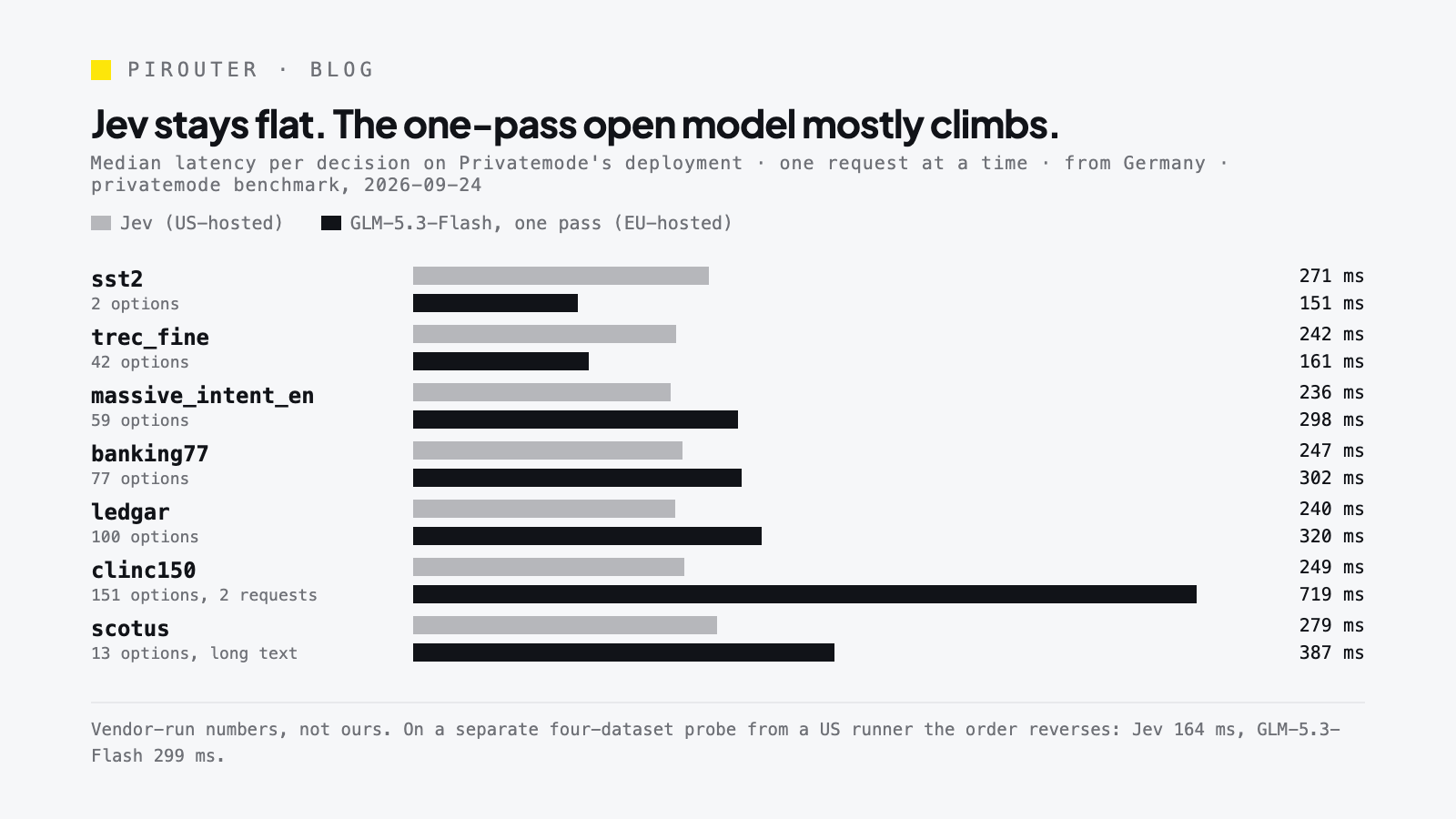
The headline 152 ms versus 251 ms was measured one request at a time from Germany, near Privatemode’s EU deployment and farther from Jev’s US service. In a separate four-dataset geographical probe, taken on another day from German home broadband and a US cloud runner, the order switched: approximately 180 ms GLM versus 264 ms Jev from Germany, but 164 ms Jev versus 299 ms GLM from the US. These are not contradictory figures from one run. At 12 concurrent requests on one dataset, both reached 249 ms median, according to the benchmark’s methodology. Serving location and queueing belong in any buying decision; see our gateway latency measurement guide.
Longer prompts and bigger option lists complicate the story. In Privatemode’s per-dataset table, Jev’s median ranged from 235 to 284 ms over its 28 datasets. One-pass GLM took 161 ms on a 42-option set, 302 ms on banking77 with 77, 320 ms on ledgar with 100, and 387 ms on a 13-option set of long court opinions. The 151-option clinc150 took 719 ms: Privatemode’s particular deployment returned at most 128 requested token log-probabilities per response, so the library sent two requests in parallel. Those examples do not isolate prefill cost from readout overhead or deployment effects. Do not generalize a smooth “more options means slower” curve from them.
The bill is easier to establish within this historical benchmark. Its pricing code uses EUR 0.20 per million GLM input tokens on Privatemode, versus USD 0.042 for Jev, converted using 0.92 EUR per USD. That is about 5.2 times per input token. The benchmark estimates a smaller fixed prompt wrapper for GLM (55 versus Jev’s 270 tokens) but a larger per-option wrapper (20 versus 10). At about 21 options the token counts cross—not the prices. Jev was cheaper on every shared dataset: GLM cost about twice as much on simple two-option sets, 8.8 times as much on ledgar, and 20.7 times as much on clinc150, by our calculations. Discounts, caching and different traffic would change your own bill.
A confidence score is not the chance that the answer is correct
The open library computes confidence from how concentrated its option probabilities are: 1 - entropy / log(number of options) (library README). TypeSafe likewise describes Jev’s confidence as derived from the distribution (confidence documentation). A sharp but wrong prediction can still score highly. The decision metric is how many examples can be automated while keeping the automated subset at the accuracy your use case requires.
In the benchmark’s mean coverage at 95% accuracy column, Jev reaches 49%, reasoning GLM 48%, one-pass GLM 43% and embeddings 16%. That leans Jev’s way for selective automation, but each arm uses its own confidence score, the GLM results include a scanned-document set Jev could not answer, and the authors do not give a significance test for this column. Do not import its threshold into your business workflow: check coverage at a threshold calibrated against your own labelled decisions.
Reasoning GLM is more accurate overall in this suite and costs about EUR 0.35 per thousand decisions at the benchmark’s old price, versus EUR 0.062 for one pass. It averaged 7.2 seconds per decision and hit a 4,000-token reasoning budget without an answer on 62 of 35,686 decisions (suite and methodology). This is a real trade, not a slower version of an otherwise identical product.
There are subtler failure modes. A distribution over supplied options cannot say “none of these” unless you add that option. Option ordering can matter, so the open library can rotate choices with permutations=k, at k times the inference cost. Renaming true/false to correct/wrong hurt GLM by about 20 accuracy points on one dataset, versus about three for Jev; over all shared renamed sets, however, both had a roughly 6.5-point median decline by our count. Naming changes the task as well as testing robustness. Version changes can move calibrated thresholds too: TypeSafe recommends pinning jev-1.13.0, and the open implementation refreshes tokenizer IDs when a model alias can move.
Self-hosting GLM-5.3-Flash buys control, not cheap decisions by default
“Open model” covers two different purchases: calling the open weights on Privatemode’s hosted service, and operating those weights yourself. Only the former appears in the priced and timed head-to-head above. The GLM-5.3-Flash model card lists an MIT license, image input and 320 billion total parameters, of which 18 billion are active. Native FP8 weights occupy roughly 306 GiB before runtime and KV cache, and the vLLM deployment recipe uses four-way tensor parallelism with a GB200 tray and reports validation on four H200s. “Flash” describes its design, not single-GPU deployability.

At one million 400-input-token decisions per month, Jev’s documented September list rate of USD 0.042 per million input tokens implies about USD 16.80, by our arithmetic. A dedicated multi-GPU host is hard to justify solely to displace that example bill; whether an existing, well-utilized cluster wins depends on its actual utilization and operating costs. The benchmark wisely labels local model expense “local,” not zero. Open weights still need a host.
Self-hosting can instead keep data inside your network and give you an exit if one API’s terms or availability change. TypeSafe says it does not train on customer requests and offers zero-data-retention arrangements for enterprise customers (legal terms); Vercel’s Jev gateway listing describes per-request zero retention and no-training options. Those policies are not equivalent to not sending input to a third-party endpoint. Privatemode claims encrypted-in-use hosting with client-checked attestation, a third option we have not assessed. Self-hosting brings its own security and maintenance responsibilities. The public benchmark gives no evidence that a smaller, cheaper open model would preserve GLM’s accuracy; test that proposition separately.
Which decision path would I test first?
| Situation | Starting point | Important boundary |
|---|---|---|
| Text-only, high volume, data can leave your network | Jev | Early access; documented rate limits may change and its low price may not persist |
| You already operate multi-GPU inference and require local data | One-pass open model on your own vLLM | Measure utilization, tokenizer behavior and labelled-task accuracy |
| EU hosted inference with confidential-computing claims | Privatemode-hosted GLM | Attestation and privacy claims need your own assessment; benchmark price is historical |
| Scans and other images need a typed choice | Vision-capable open model | GLM scored 70.2% on the benchmark’s scanned-document set; compare a task-specific classifier |
| Need explanations, generated fields or difficult judgments | LLM classifier with reasoning | More accuracy can cost seconds; measure timeouts |
| Simple semantic labels and extreme cost sensitivity | Embedding similarity | This zero-shot baseline lost to majority-class guessing on five of 28 sets |
| Counting, dates, amounts or strict policy rules | Code and explicit rules | Jev’s own limitations warn against numeric precision tasks |
For a real selection, label a few hundred decisions from your own traffic, including ambiguous and “none of these” cases. The benchmark README explains how to add a dataset Spec, curate it and run repeated trials; its Privatemode arm uses that vendor’s proxy, so running against your own vLLM requires adapting the harness. Compare paired errors, not only aggregate accuracy. At 300 examples, a two-point difference represents six cases—too fragile to settle procurement without repetitions and the paired uncertainty calculation. Then evaluate confidence-gated coverage, p95 latency from your users’ region, and the actual monthly bill including idle GPUs.
The published tie is worth taking seriously, not taking literally as a migration plan. If your labelled traffic, locality and compliance constraints favor Jev, its tiny historical per-decision bill is difficult to ignore. If keeping the weights and data in your control is the requirement, budget for the actual machine and verify that one-pass probabilities remain useful on your labels. The decision belongs to your workload, not to the benchmark’s headline.