
Fireworks Forge: Ultra-fast Preview and the Limits of Half Price
Forge pairs an Ultra-fast public preview with cheaper deferred work. Here is what Fireworks actually says about speed, Background Mode, Batch, Spot and access.
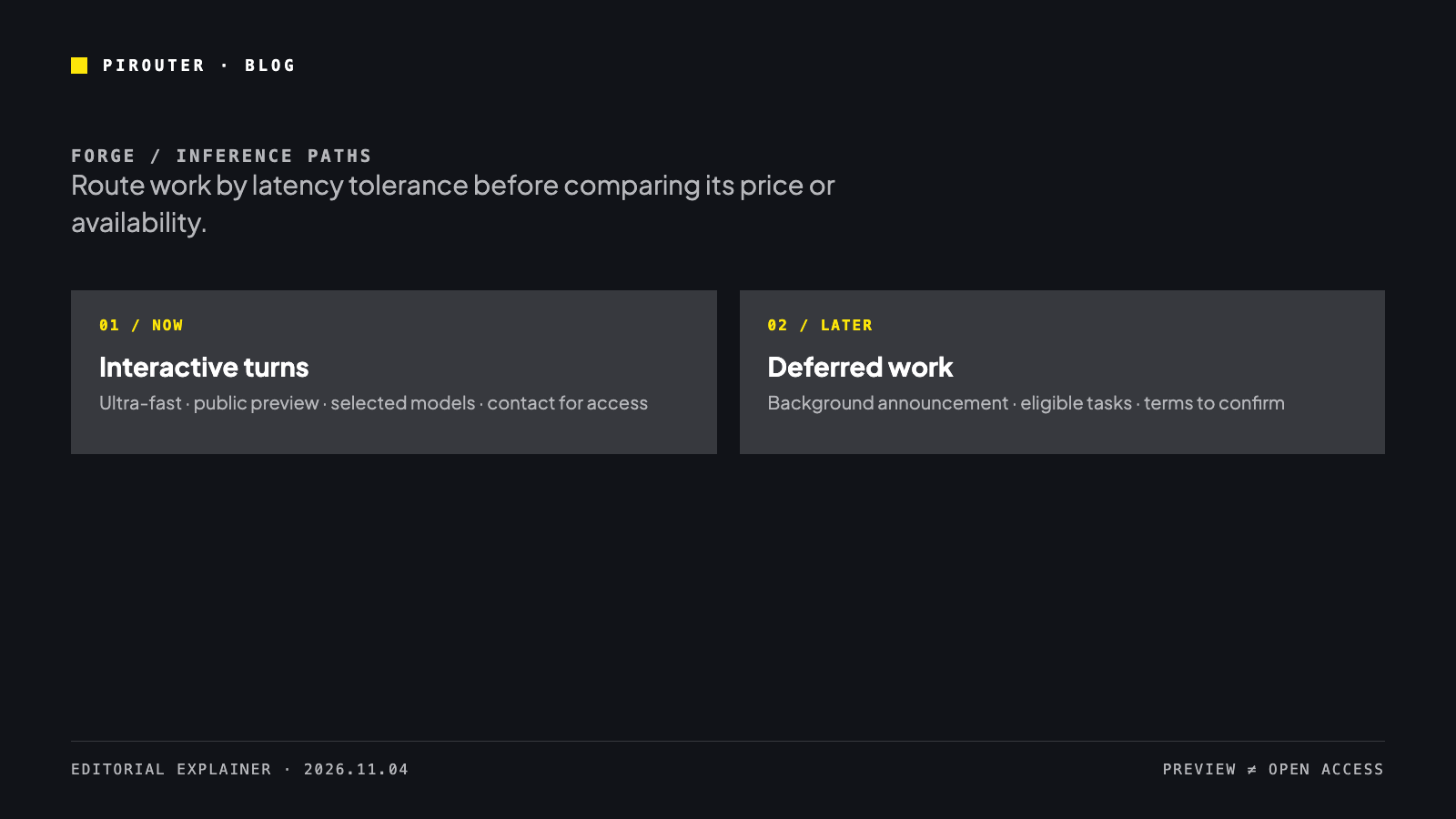
Fireworks’ November 3 Forge announcement makes a useful distinction: an agent’s next interactive turn and an overnight job should not necessarily buy the same inference service. Ultra-fast is a public preview aimed at the first problem; Background Mode promises half-price execution for eligible work that can wait. The catch for anyone planning a budget is that the Forge announcement and Fireworks’ live pricing page describe several different modes. A matching percentage is not proof that they share an API contract, an eligible model list or an access path.
Why does a 30-turn agent care about Ultra-fast?
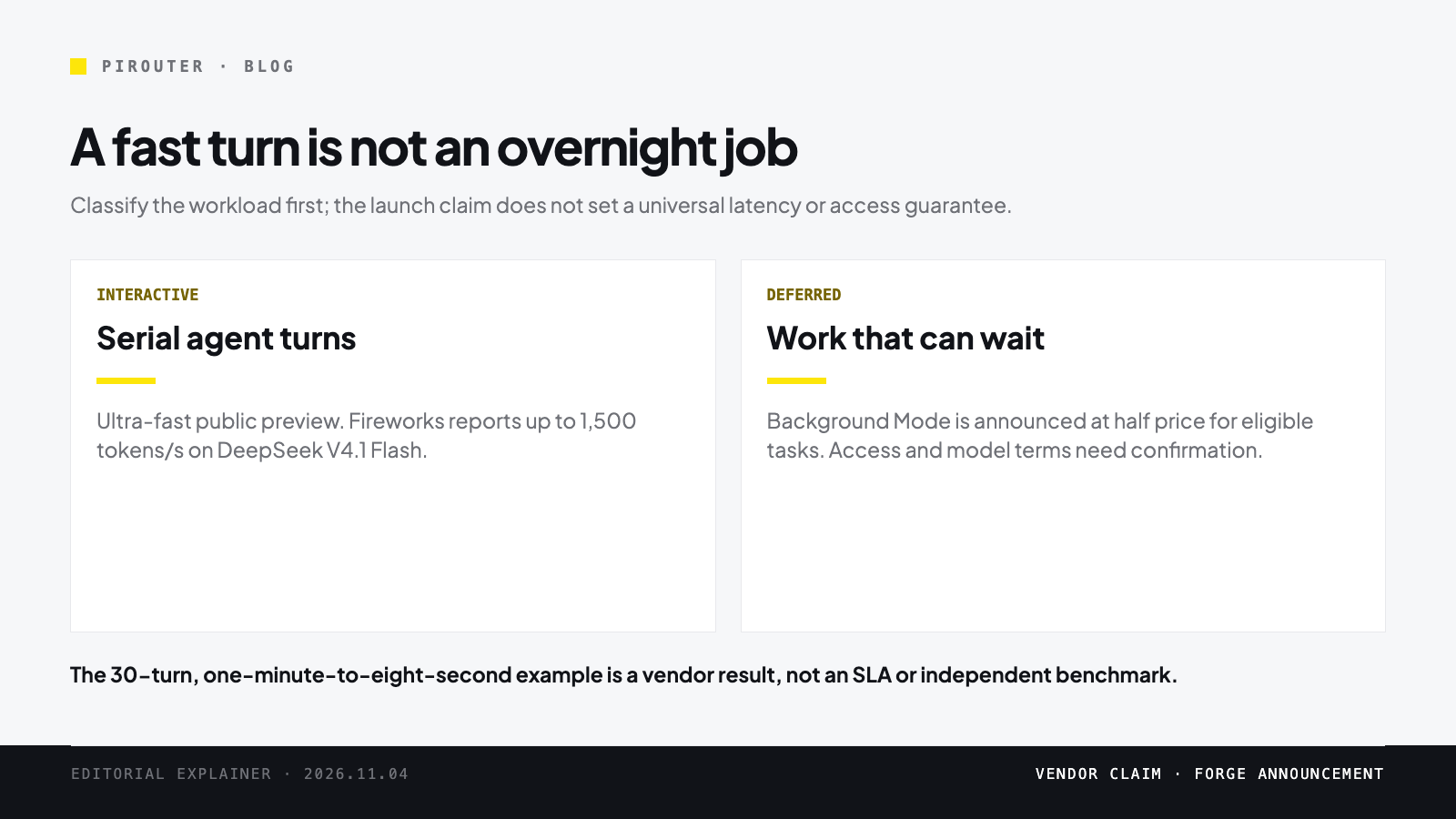
If a user is watching an agent call tools, read results and decide on its next step, each generation can hold up the next one. Fireworks says its Blackwell-powered Ultra-fast preview delivered up to 1,500 tokens per second on DeepSeek V4.1 Flash. In the company’s benchmark of a 30-turn agent task, the total fell from one minute to eight seconds at Ultra-fast. That is a result reported by Fireworks for its own setup, not a measured response time for every model, client or production workload. Unite.AI’s coverage relays the company’s figures; it does not report an independent reproduction.
The speed claim is useful as a hypothesis about serial work, not a service-level promise. A task whose turns wait on tool responses or external systems may have a different bottleneck. More importantly, “public preview” describes the launch status, not universal access: the pricing page’s Ultra-fast section says the mode is in preview for specific models and asks customers to contact Fireworks for access. The page does not publish a general Ultra-fast per-model price. A team cannot turn the headline tokens-per-second figure into a deployable cost-per-task estimate without confirming its model and terms.
What does “half price” cover for work that can wait?
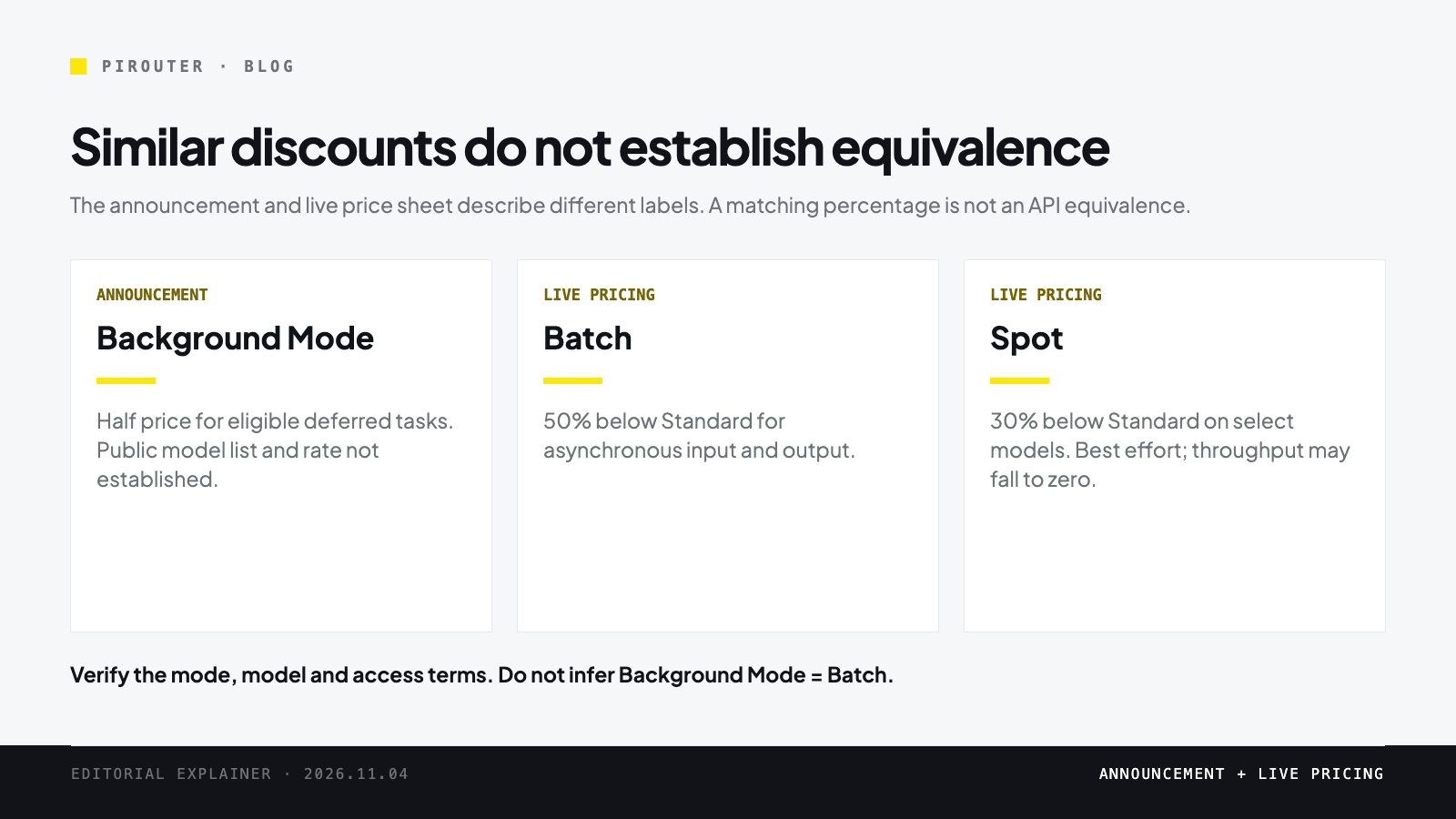
Consider a separate, hypothetical job: generate evaluation data overnight, then inspect the results in the morning. Fireworks offers Background Mode at half price for eligible work of that sort in its announcement. The eligibility qualifier matters more than the tidy number. The announcement does not give us an exhaustive model list or a public per-model Background rate, and the live price sheet does not list Background as a separately priced mode.
The current pricing page does list Batch: asynchronous work at 50% below Standard for input and output. It also lists Spot, priced 30% below Standard on select models, for traffic that can retry or fall back. Spot uses best-effort capacity; its throughput can fall to zero. These are useful public terms, but they do not establish that the announcement’s Background Mode is an alias for Batch, or that every deferred request qualifies for either discount. One page even recommends Spot for retryable background traffic. “Background work” as a workload description and “Background Mode” as an announced product label should not be collapsed into a billing instruction.
That difference changes the choice. A job with a deadline but no need for interactive responses may fit an asynchronous batch route; a job that can tolerate interruption may fit best-effort capacity. Neither conclusion follows from the words “half price” alone. Confirm the request mode, eligible model, retry behavior and actual rate in the current product terms before projecting savings. No paid test or invoice underlies this article.
Caching and burst capacity solve different problems
Waiting is not the only source of agent cost. An agent that resumes with the same lengthy instructions or working context may pay to process that input repeatedly. The Forge announcement introduces multi-day Prompt Caching for repeated context. The pricing page describes automatic caching with no setup or write charge and cached-token rates that vary by model. Neither page establishes a universal multi-day retention promise, hit rate or discount for every model. Cache savings depend on how much context actually repeats and hits; an advertised retention window is not a bill.
For concurrent agents, Fireworks separately says higher serverless rate limits and Elastic Burst are generally available. Elastic Burst can exceed the usual ceiling when spare capacity exists, with no code or pricing change according to the announcement. That is a concurrency option, not a guarantee that spare capacity will be available at every peak. Ultra-fast remains in public preview: general availability for rate limits does not make every Forge feature generally available.
The practical first step is to separate an interactive path from a retryable or deferred one and note which context repeats. Then check the live model-and-mode combination, access approval, fallback behavior and invoice semantics before changing production traffic. Forge makes the urgency split worth examining; its launch figures alone cannot settle the buying decision.